What a House Cost in 1985 vs. Today
Ask anyone what a house cost "back then" and you'll get a number that sounds like a fairy tale, followed by a shrug about why it still doesn't feel like the good old days once you actually do the math. In 1985, the median home in America sold for around $75,500, with mortgage rates sitting above 12 percent. Here's what that number actually meant for a family's monthly budget, why the room that came with it ended up covered in brass and mauve, and which parts of that story are still worth borrowing for your own home today.
The Room We All Remember
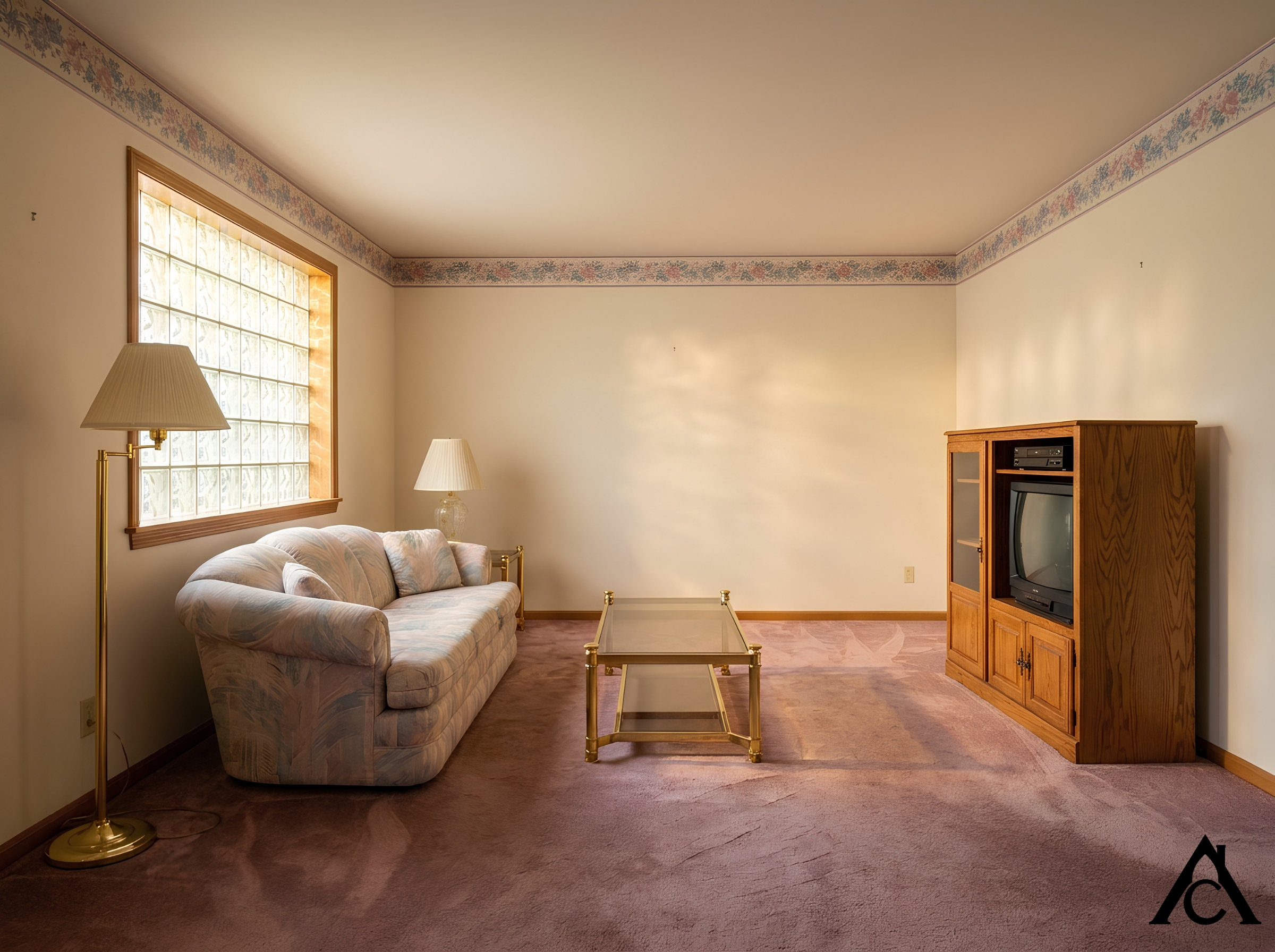
Before we get to the numbers, it's worth sitting in the room itself for a second. A 1985 living room had a very specific texture — mauve or dusty-rose carpet underfoot, brass on every hinge and lamp base and ceiling fan, a glass block accent wall doing double duty as light source and privacy screen, mirrored closet doors making a small bedroom feel twice its size. It was warm, a little shiny, and completely unmistakable for any other decade.
That look wasn't an accident, and it wasn't just taste. It was downstream of three numbers: the price of the house, the rate on the mortgage, and what a family actually brought home. Once you see how those three moved between 1985 and today, the room starts to make a lot more sense.
So, What Did a House Actually Cost?
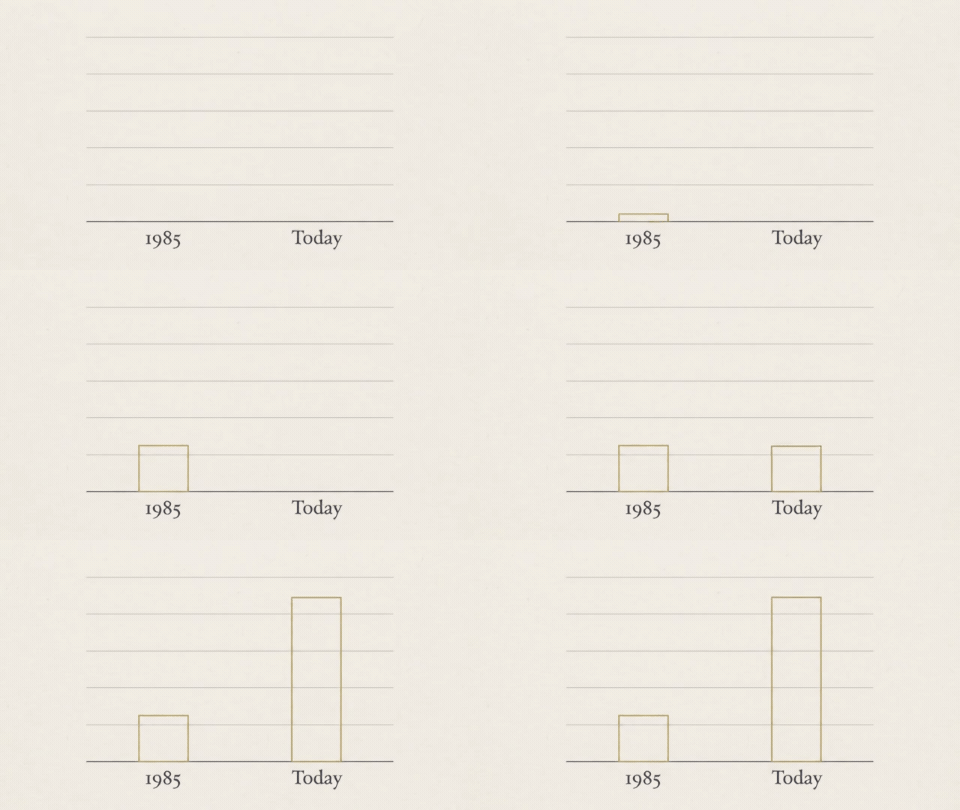
Here's the part that trips most people up: there isn't one 1985 home price, there are two. The median existing home — the kind most families were actually buying — sold for about $75,500 that year. New construction ran higher, closer to $82,800, according to Census Bureau data compiled by Visual Capitalist. Today, depending on which slice of the market you're measuring, that number sits somewhere between roughly $409,000 and $429,000 — Census new-construction sales, NAR's existing-home median, and Redfin's broader all-homes figure all land in slightly different places, because they're counting different houses (Redfin's current housing data).
Even adjusted for inflation, today's home costs meaningfully more in real purchasing power than its 1985 counterpart did. And yet the national homeownership rate has barely budged — 63.9 percent in 1985, 65.8 percent as of the most recent clean year-over-year comparison in 2022 (U.S. Census Bureau). If the price climbed that much and ownership stayed roughly flat, something else in the equation had to move to absorb the difference. That something is the rate.
The Rate That Made or Broke You
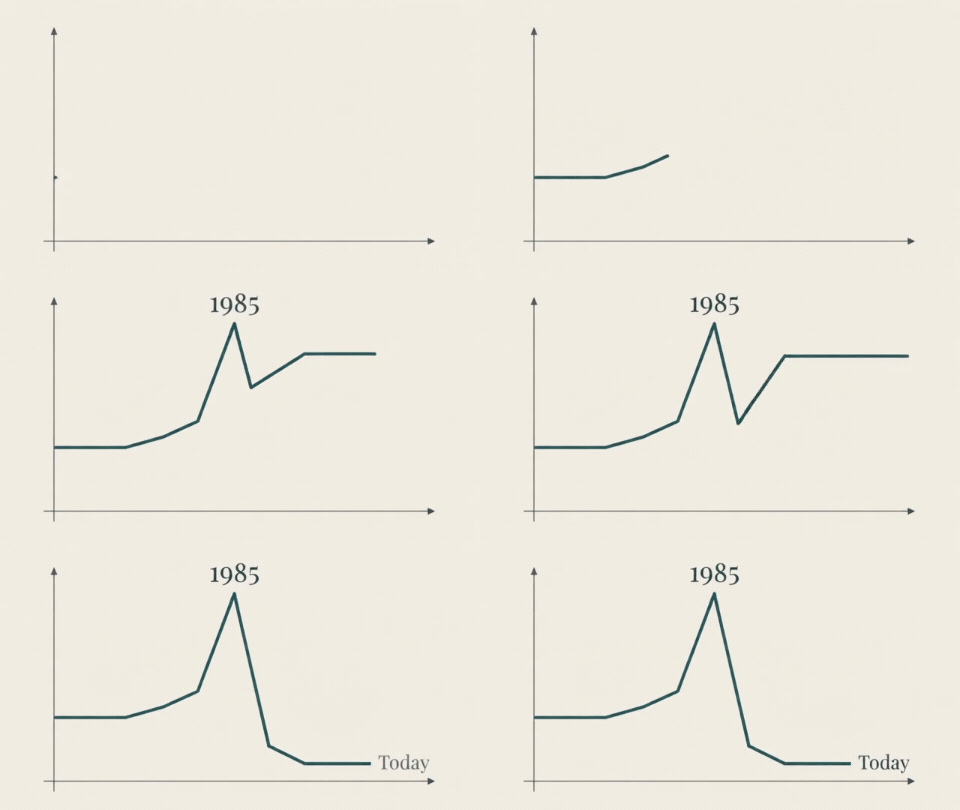
If you want to understand 1985, you have to understand Paul Volcker. As chair of the Federal Reserve starting in 1979, Volcker raised interest rates aggressively to break the runaway inflation of the late 1970s — at one point pushing the federal funds rate above 19 percent (CNBC's retrospective on the Volcker era). Thirty-year mortgage rates followed, spiking into the high teens in 1981 and staying in double digits for most of the decade. By 1985, the average 30-year rate had eased to 12.43 percent — genuinely considered an improvement at the time.
Today's average sits in the mid-6 percent range. Run the math on an identical loan amount at 12.4 percent versus 6.5 percent, and the monthly payment at the higher rate is nearly double. Which means a 1985 buyer, even paying a smaller sticker price, was often handing over a larger share of their monthly income to the bank than a buyer today. Price tells half the story. Rate tells the other half.
That high-rate environment had a quieter side effect, too: it kept people in their houses. When moving means trading your old rate for a new one that might be double, you renovate instead of relocating. A lot of 1985's decorating spending wasn't about starting fresh in a new home — it was about staying put and making the current one feel new.
Income Didn't Keep Pace
The median American family earned about $27,740 in 1985, according to the U.S. Census Bureau's Current Population Survey — a figure that had actually been climbing faster than inflation for a few years running. Set against that $75,500 median home price, the home-price-to-income ratio worked out to roughly 3.5. By 2025, that same ratio had climbed to about 5.0, among the least affordable readings in decades (Visual Capitalist / LendingTree analysis).
That squeeze wasn't invented recently — it was already visible by the mid-1980s, which is part of why two incomes had become the norm for married-couple households buying a home well before "dual income" became a modern buzzword. A tighter housing budget also meant less room in a family's spending for furniture, which is one reason consumer credit expanded so quickly through the decade. A lot of that brass-and-mauve furniture didn't arrive in cash. It arrived on a payment plan.
A Bigger House for a Smaller Family
Here's a genuinely strange twist: while the price of a house climbed and the rate on it stayed painful, the size of the average new home kept growing. In 1985, the average new single-family home measured about 1,785 square feet (Census Bureau data via 24/7 Wall St.). Today, that average sits closer to 2,400 square feet (LendingTree analysis of Census Characteristics of New Housing data) — even as the average household got smaller over the same stretch.
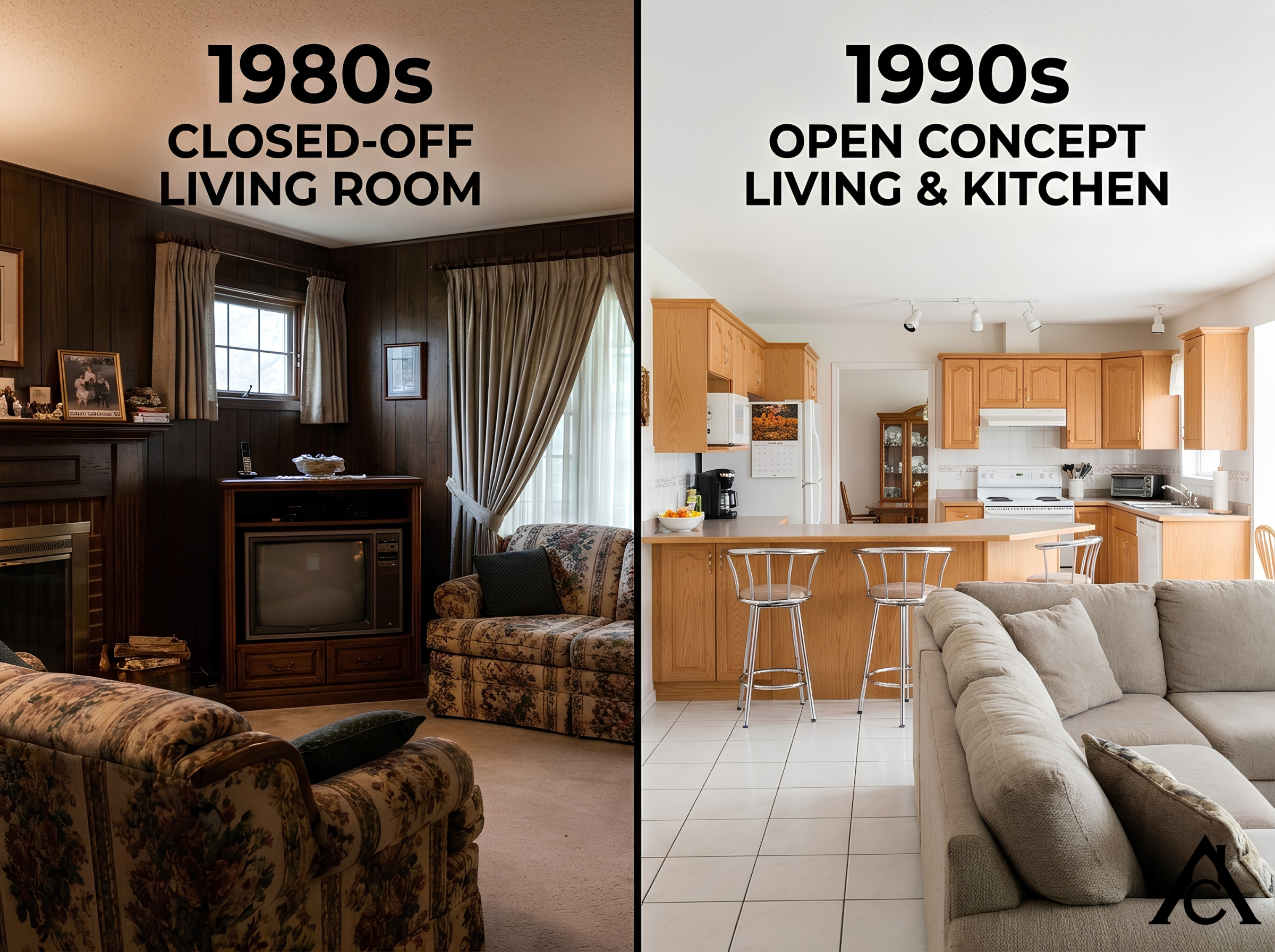
That extra square footage changed the shape of the room, too. A 1985 house was still built as a set of boxes — a formal living room, a family room, a kitchen, each with its own closed door. Starting in the 1990s, those walls began coming down, merging kitchen, dining, and living space into the single open room most of us take for granted now. More square footage didn't automatically mean more togetherness. Sometimes it just meant more rooms nobody used every day.
Why Brass and Mauve Happened
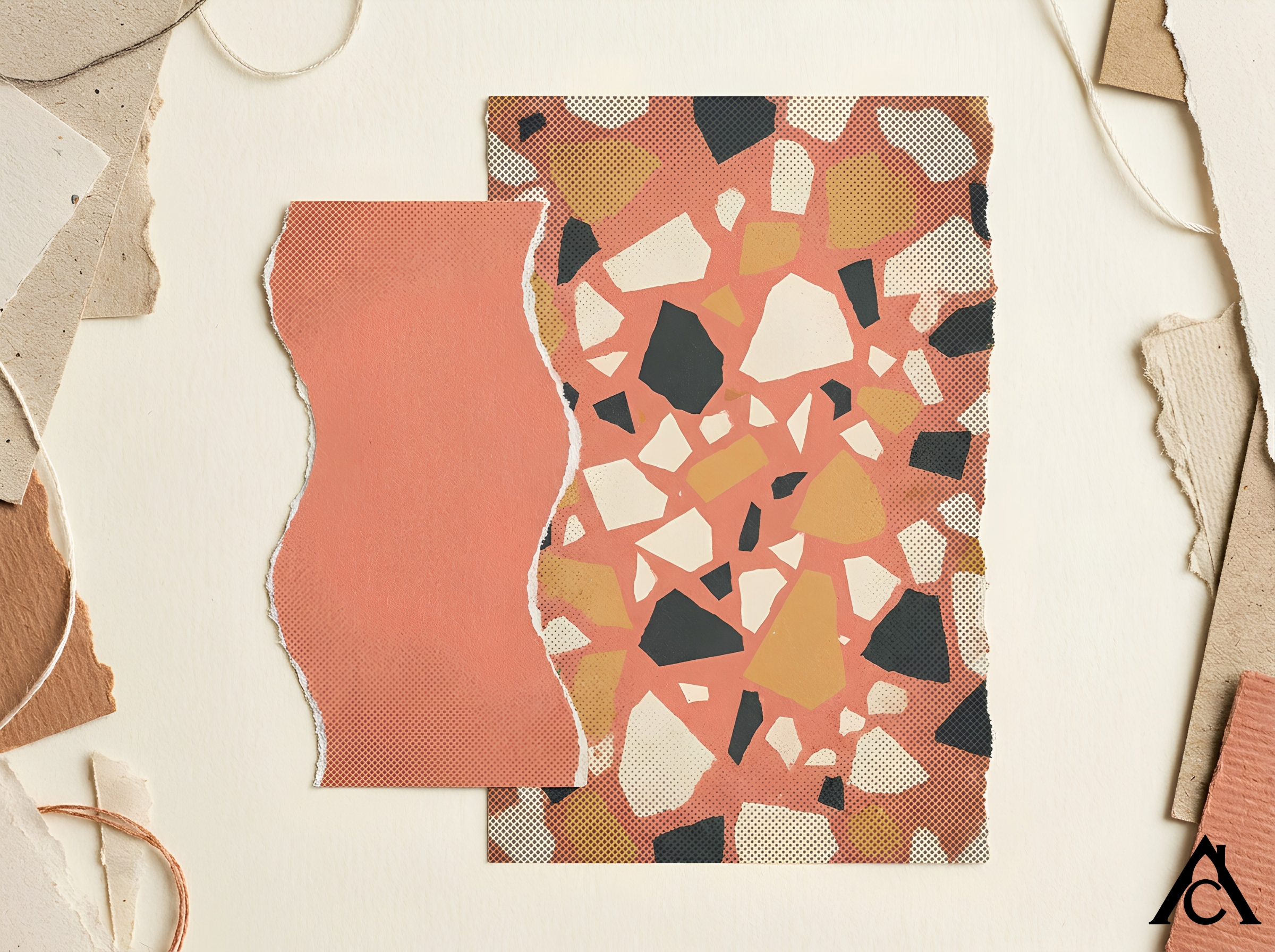
This is the part that turns a spreadsheet into a story. In 1981, a group of Italian designers working in Milan — led by Ettore Sottsass and known as the Memphis Group — launched a defiantly bold, clashing, postmodern furniture movement: hot-pink laminate, asymmetrical shapes, terrazzo surfaces, glass block, patterns that argued with each other on purpose (Lewith & Freeman's design history overview). The group's most famous piece, the Carlton bookcase, later turned up in David Bowie's private collection — that's how seriously the design world took it.
Almost nobody actually put a Carlton bookcase in their living room, though. What happened instead is the pattern from the 1970s episode all over again: a bold, high-concept movement got simplified as it trickled down into ordinary showrooms. Full-strength Memphis was too loud for most households. Mauve and dusty rose were the safe, wearable version of that same energy — current-feeling without fully committing to hot pink and squiggles. Brass, meanwhile, photographed like money, and in a decade chasing visible status, that mattered.
There was also a financial mechanism quietly fueling all of it. The Tax Reform Act of 1986 eliminated the tax deduction for interest on most consumer debt — credit cards, car loans — but kept the deduction for mortgage and home-equity interest (Congressional Research Service report via Congress.gov). Almost overnight, borrowing against your house became the tax-smart way to pay for a renovation, and a lot of that home-equity money went straight into brass fixtures, glass block, and freshly laminated countertops. Rising home values gave owners the equity to borrow against; the tax code gave them a reason to spend it on the room.
What Today's Money Buys Instead
If 1985 signaled money with shine, today's equivalent signals it with restraint. The dominant palette right now isn't bold or pastel — it's warm neutral: taupe, greige, warm white, walnut, described across multiple 2026 design-trend reports as "warm minimalism" (StyleBlueprint's 2026 trend roundup). Laminate's modern replacement is engineered quartz, priced and marketed almost exactly the way brass was in 1985 — a material that photographs like quiet luxury (MSI's 2026 quartz color trend coverage). Open concept still dominates new construction, though there are early signs of builders quietly bringing back some defined rooms.
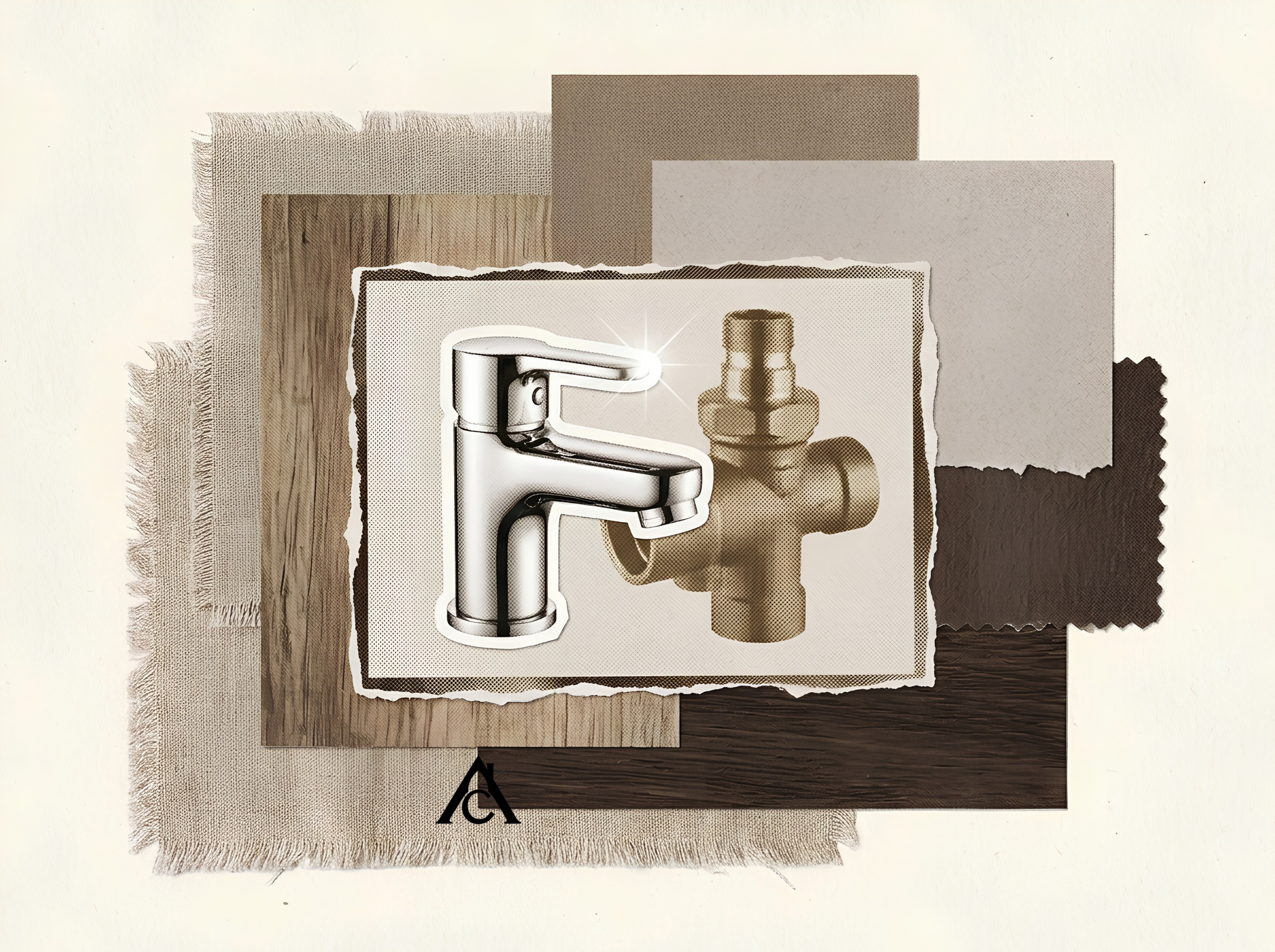
And in one of those small, funny design-history loops, polished chrome and nickel fixtures were creeping back into 2026 kitchens right as this article was written — a resurgence designers are describing as "subtle nods to the '70s" (Homes & Gardens' 2026 kitchen trend report), arriving almost exactly one design generation after brass took over. Materials really do cycle back around roughly every generation. The room around them never looks quite the same twice.
What to Borrow From 1985 for Your Own Room
You don't need wall-to-wall mauve carpet to borrow what actually worked about that era. One confident material choice, fully committed to, does more nostalgic work than copying the whole room: a single brass lamp or mirror frame gives you the era-nod without dating the space. A curved, sculptural mirror captures the same optimism a full mirrored wall did, without the full 1985 commitment. And the instinct underneath all of it — a well-made piece, real stone, solid wood — ages the same way it did in any decade: gracefully.
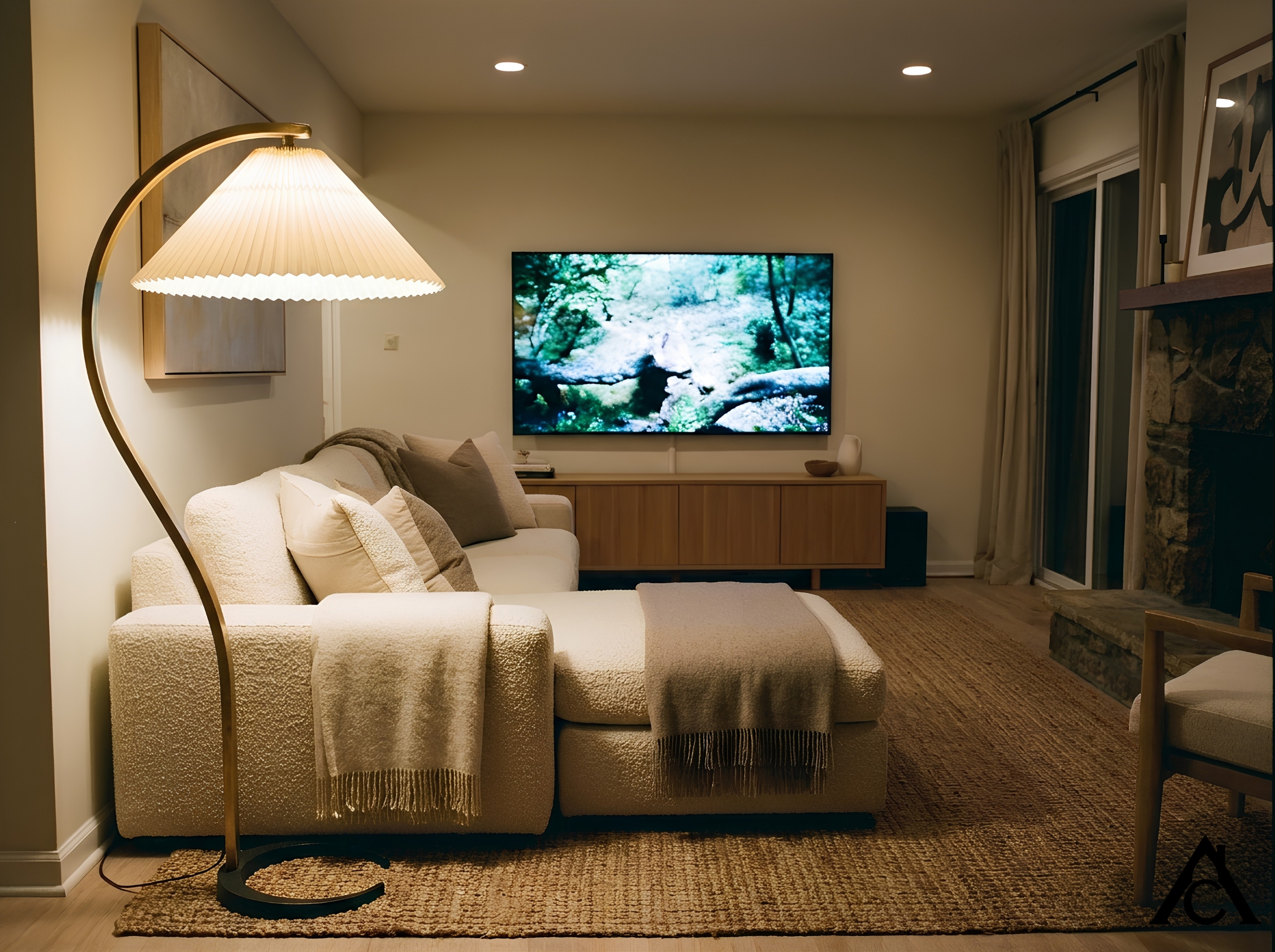
That instinct matters even more if you're staging a home to sell rather than decorating one to keep. Staging isn't about erasing personality, it's about editing the clutter down so a buyer can actually picture living there. According to the National Association of Realtors' 2025 Profile of Home Staging, 83 percent of buyers' agents say staging makes it easier for a buyer to visualize a home as their future residence, and the living room is the single most commonly staged room in the house (NAR's 2025 Profile of Home Staging).
The Unglamorous Part: Insurance and Resale
None of this shows up in a listing photo, but it's worth saying plainly: older wiring, older plumbing, and older roofs cost more to insure today than newer systems do, simply because they raise the odds of an expensive claim. National average home insurance premiums have climbed sharply since 2020, now running somewhere in the $2,700–$3,000 range annually depending on coverage and methodology (Forbes Advisor's 2026 home insurance cost analysis). Updating an aging system is real money up front — but it's still far cheaper than the alternative, and it's often exactly what a buyer's inspector notices first. The boring infrastructure work is what lets the pretty decorating actually last.
So, What Actually Changed?
Strip it all the way down and the story is this: the price climbed, the rate fell, the house grew, and the room learned to whisper instead of shout. None of that math ever really rests — rates rise and fall, palettes swing loud then quiet then loud again, and every generation ends up furnishing itself out of whatever the economics of that decade will actually allow. The 1985 living room wasn't decorated by accident. Neither is the one you're standing in right now.
