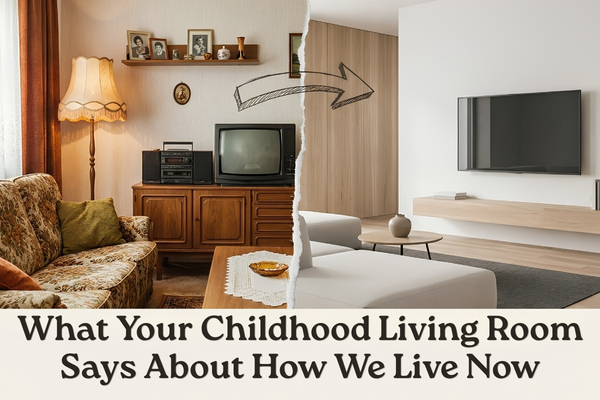
What Your Childhood Living Room Says About How We Live Now
Close your eyes, and your childhood living room rarely comes back as a deliberate floor plan or a coordinated color scheme. It returns first as texture and light. You remember the prickly rib of corduroy upholstery, the deep pile of shag carpet worn into a distinct, pale path between the sofa arm and the kitchen threshold, or the low, warm amber glow cast from a heavy ceramic table lamp staged in a dim corner.
You remember the quiet sound of a cushion slowly settling after someone stood up, the dull clink of a glass on an unvarnished coaster, and the low, companionable hum of a television screen that lived inside an actual wooden cabinet.
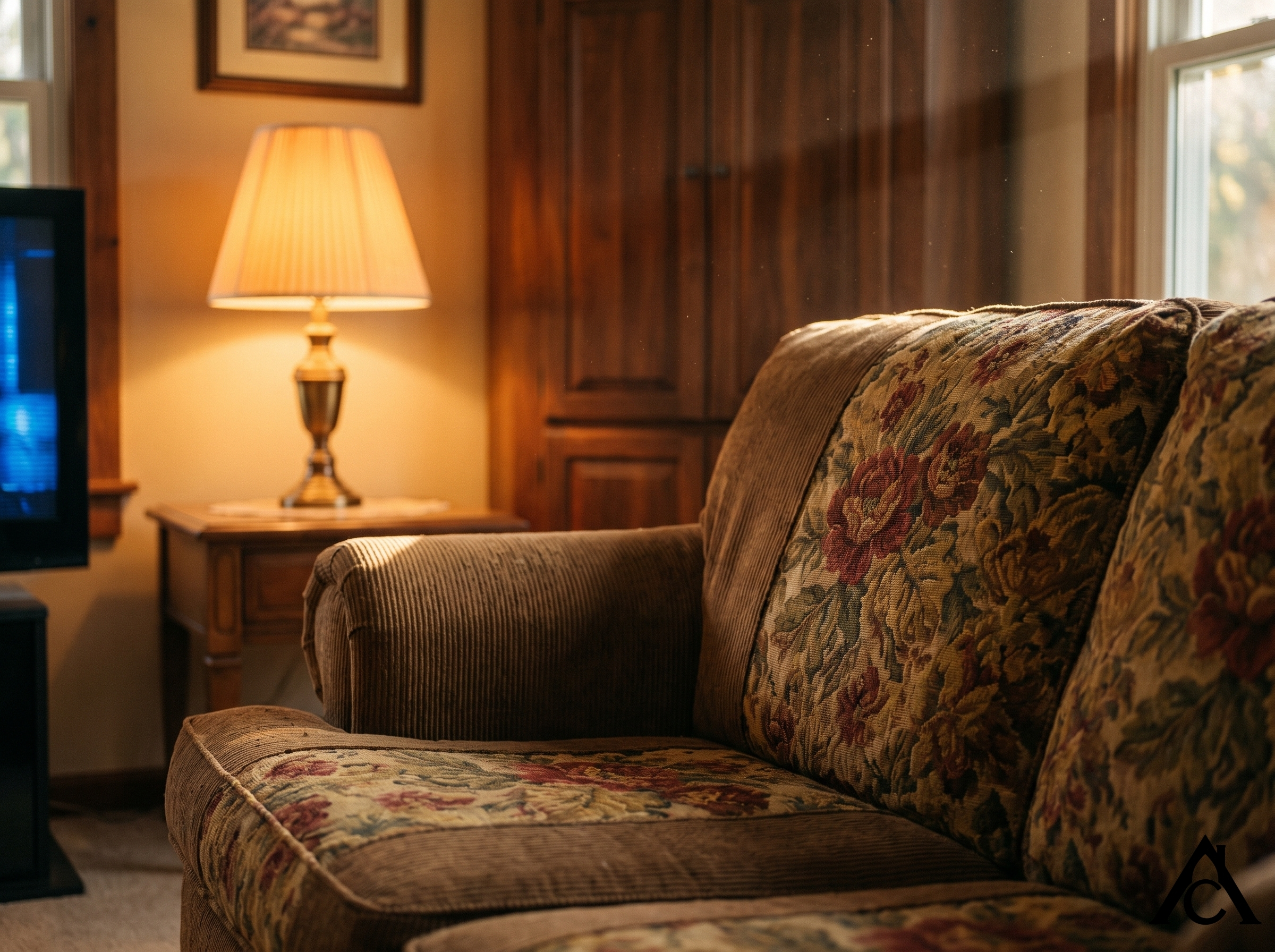
At first glance, it is tempting to dismiss those spaces as quaint relics of outdated taste — monuments to suburban kitsch, clunky furniture, and questionable color swatches. But domestic spaces have never been purely about aesthetics. A living room is an accidental archive of what a household valued, what it could afford, what it chose to protect, and the subtle technological revolutions quietly unfolding within its four walls.
Every layout decision, clear plastic slipcover, mismatched side table, and conversation zone was an ongoing negotiation between daily comfort, economic reality, and human behavior. When we look closely at how those rooms were put together, we start to understand not just where we came from, but why our contemporary homes look and feel the way they do today.
The Postwar Promise: Ownership, Order, and the Television Wall
The modern living room as we understand it was forged in the decades immediately following World War Two. As suburban developments expanded and accessible financing transformed the domestic landscape, the concept of a dedicated, private family living room became a widespread reality.
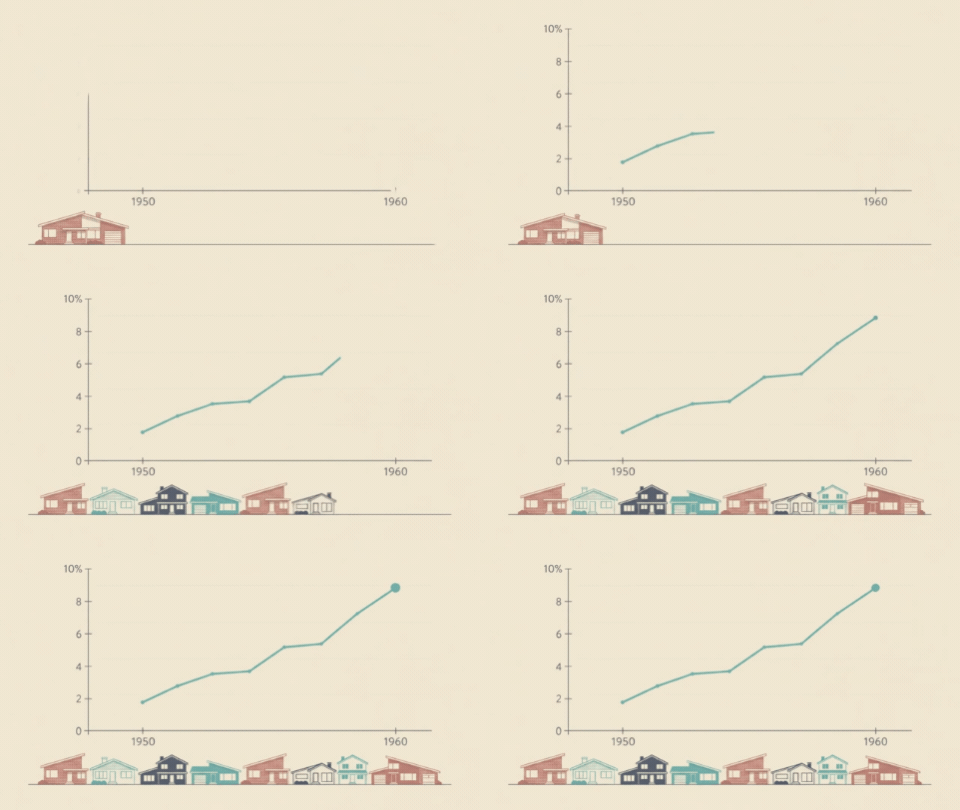
According to historical housing data from the U.S. Census Bureau, U.S. homeownership rose sharply from around 55% in 1950 to over 60% by 1960. For millions of working families, stepping across that threshold represented a profound milestone of stability, privacy, and postwar dignity.
These new suburban spaces were modest by modern standards, but the design philosophy was built on optimism. Cheerful palettes of turquoise, coral, and sunny yellow replaced wartime austerity, while lightweight furniture with slender, tapered legs created an optical illusion of height and airiness in compact footprints. Buying a coordinated suite of furniture was not merely a matter of convenience; it served as tangible, public proof that a family had arrived.
Yet the most radical domestic transformation of the 1950s did not come from an architect; it arrived inside a polished wooden box. According to historical records from the Smithsonian's National Museum of American History, nearly 90% of American households owned a television set by 1960. The television dressed itself up as fine cabinetry to earn its place in the parlor, but its cultural impact was immediate.
It competed with fireplaces, picture windows, and upright pianos for the title of the room’s focal point. Almost overnight, armchairs and sofas broke their traditional conversational circles and reoriented toward a glowing screen. Television brought families into the exact same room night after night, but proximity, as design history quickly revealed, was never quite the same thing as conversation.
The Layered 1970s: Earth Tones, Energy Shocks, and Everyday Life
By the late 1960s and 1970s, the rigid formality of the mid-century parlor gave way to a deeper, more tactile lifestyle. Floor plans began incorporating family rooms, sunken conversation pits, and split levels, allowing households to separate formal entertaining from the casual, sock-footed reality of daily domestic life.
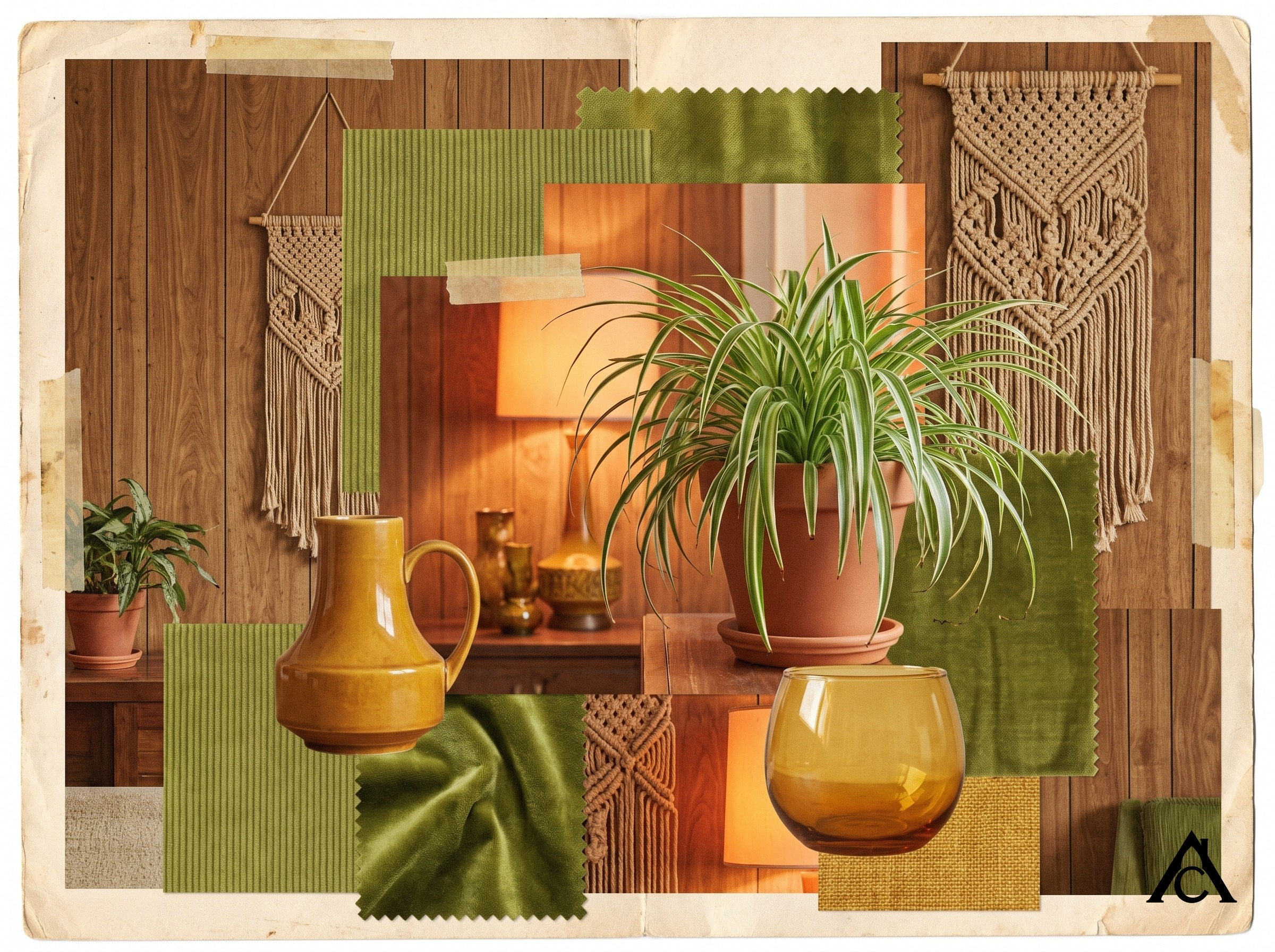
This era was famously, unapologetically saturated. Dark walnut wood paneling, exposed ceiling beams, macramé wall hangings, and spider plants in terracotta pots created rooms that felt like a warm, heavy embrace. Color palettes swung decisively toward avocado green, harvest gold, rust orange, and deep chocolate brown.
While modern eyes often view this brown spectrum as excessive, earth tones were remarkably practical: they absorbed daylight softly, flattered the warm incandescent glow of table lamps, and hid the spills and scuffs of growing families far better than delicate modern pastels ever could.
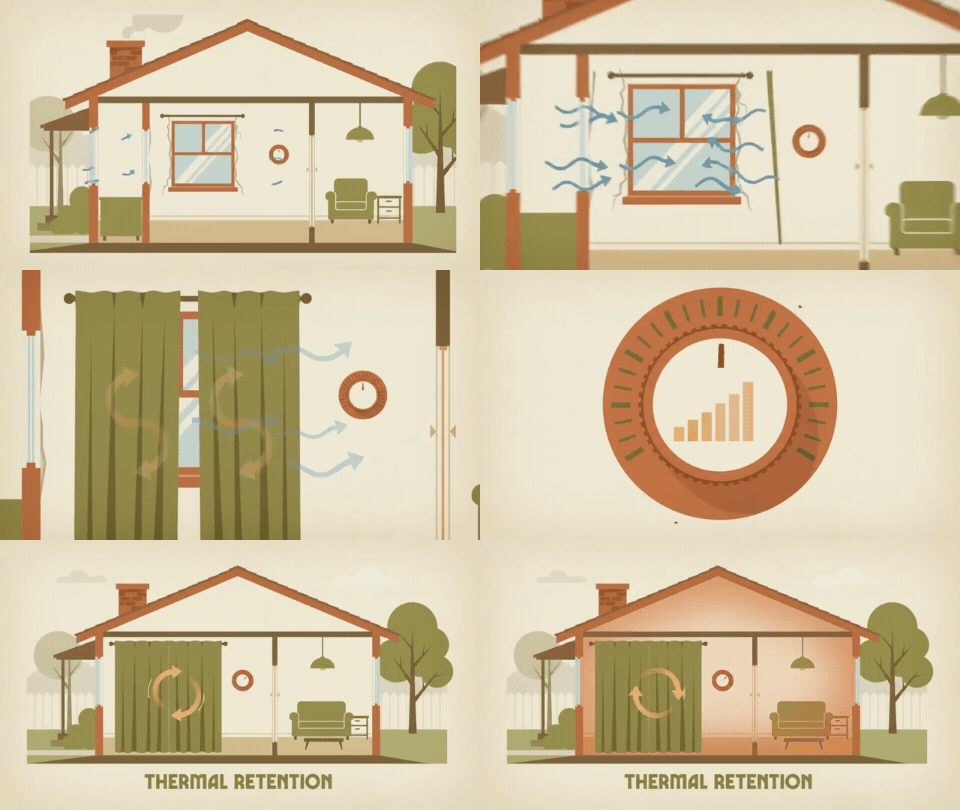
Crucially, the aesthetic of the 1970s was deeply entangled with macroeconomics. The 1973 energy crisis forced homeowners to think critically about insulation, heating bills, and thermal comfort, as documented by the U.S. Department of Energy. Heavy, lined window draperies and wall-to-wall carpeting were not just styling choices; they acted as residential equipment designed to stop winter drafts and trap heat.
Durability superseded delicacy. A living room was built to endure real children, collect decades of vacation souvenirs, and house heavy stereo consoles built specifically for the physical ritual of playing records. It was an environment that proudly kept score of a family's shared time.
The 1980s and 1990s: Scale, Sectionals, and the Media Monument
As suburban square footage grew throughout the 1980s and 1990s, living rooms expanded in volume, softness, and ambition. Visual puffiness became a shorthand for abundance: oversized rolled-arm sofas, layered window treatments, polished brass accents, and glass coffee tables brought light and reflection into spaces that had spent fifteen years swathed in dark timber.
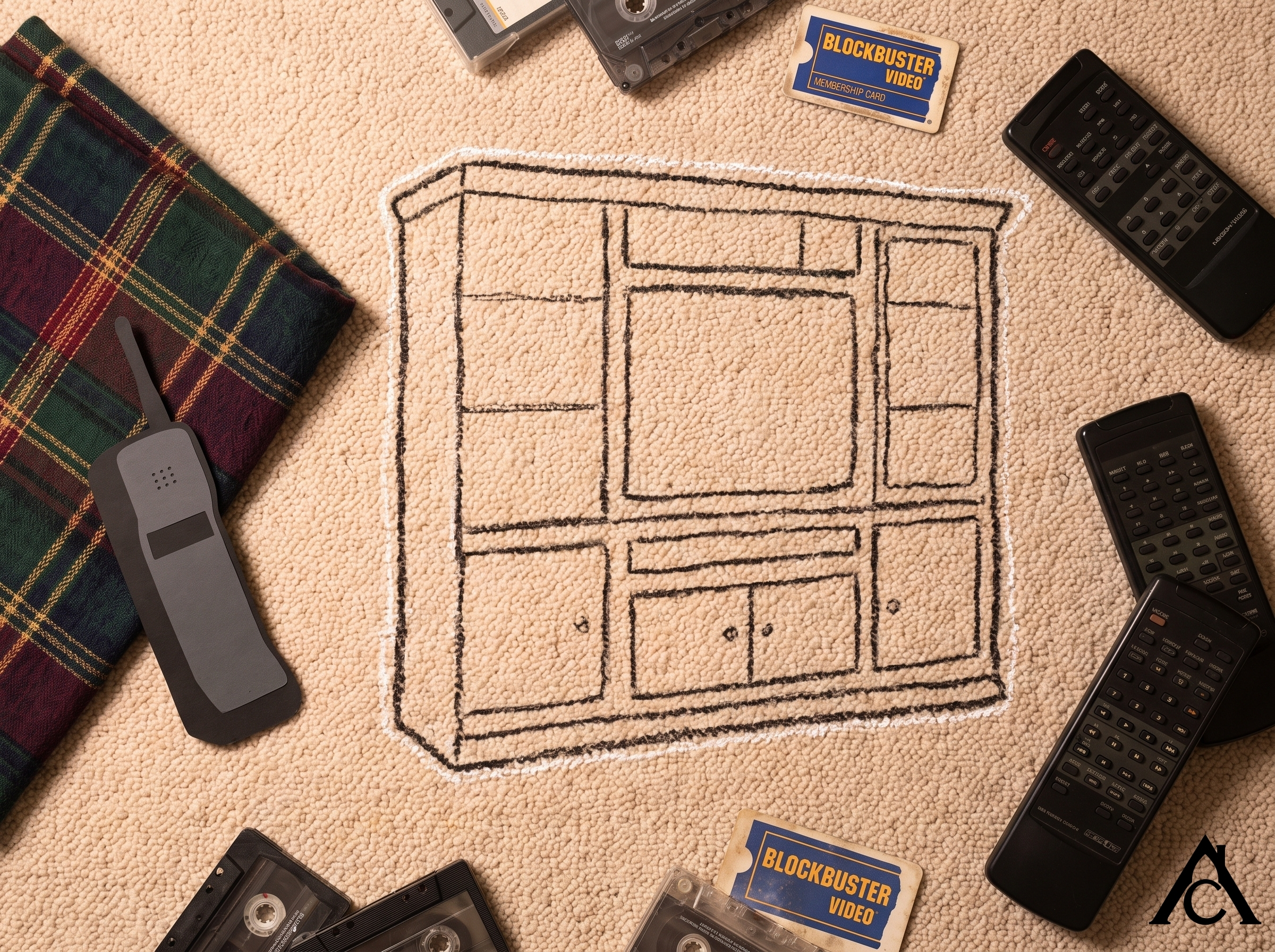
Yet economic shifts continued to dictate the pace of home life. During the early 1980s, conventional 30-year mortgage rates surged past 18%, according to historical data from the Federal Reserve Bank of St. Louis FRED. When financing a house swallowed the bulk of a household’s budget, decorating happened slowly and deliberately: one good sofa, a borrowed armchair, and a neutral beige palette that served as a sensible hedge against expensive styling mistakes.
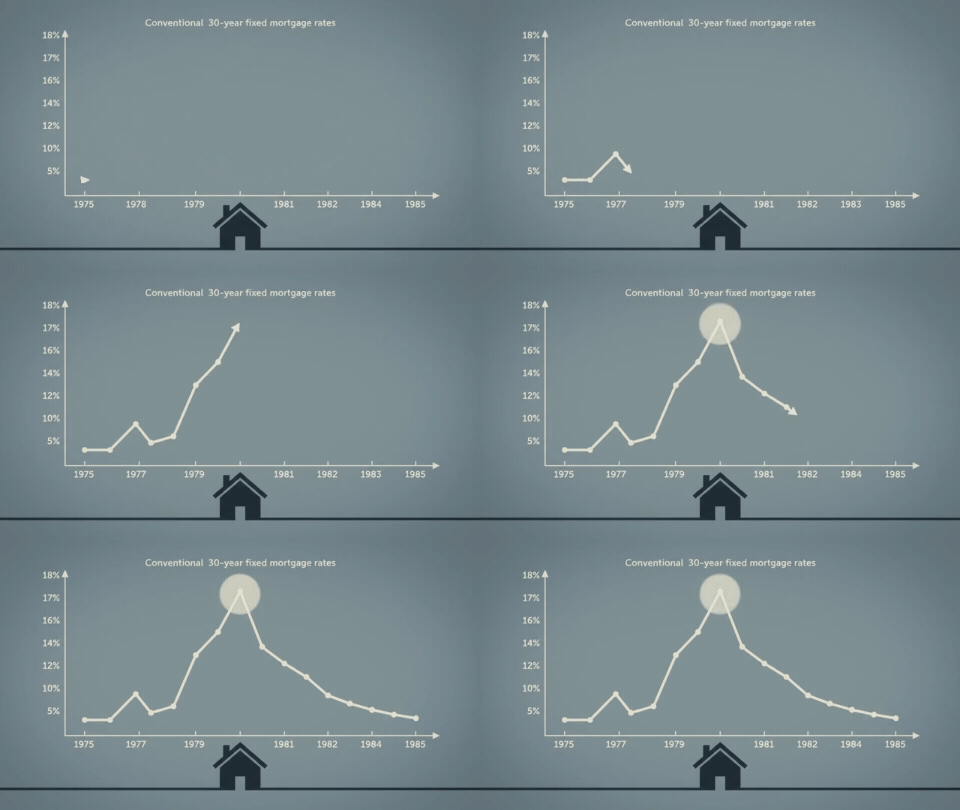
By the 1990s, the living room had become a high-traffic family command center. Massive L-shaped sectionals dictated the circulation paths of entire rooms, while mechanical recliners personalized comfort at the pull of a lever. Simultaneously, the room had to manage an avalanche of new consumer electronics.
VCRs, gaming consoles, cable converter boxes, and sprawling cassette collections required an architectural intervention. Enter the towering honey-oak entertainment center: a massive piece of cabinetry that organized tangled black wires and media clutter behind raised-panel doors.
It was an era where everyone in the house had an assigned seat, the coffee table served as an open archive of magazines and school forms, and personal artifacts were kept proudly on display.
The Digital Shift: From Lived-In Spaces to Photographed Envelopes
The transition into the 2000s and 2010s marked a dramatic spatial inversion. Cathode-ray televisions were replaced by razor-thin flat screens mounted high above fireplace mantels, liberating square footage while creating entirely new viewing angles. Interior walls were systematically removed as open-concept living merged kitchens, dining spaces, and lounges into singular, uninterrupted zones.
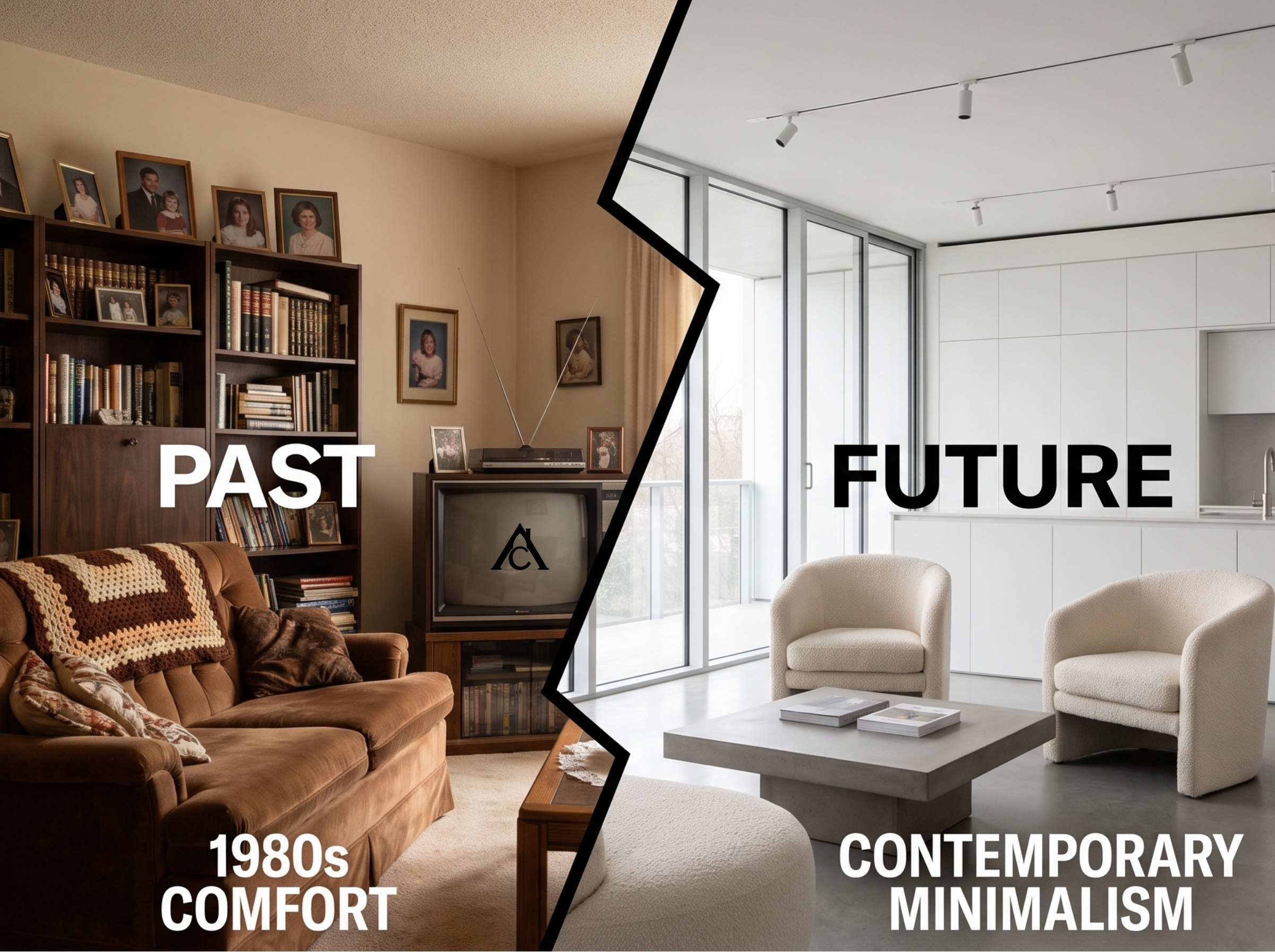
While open plans created an airy sense of togetherness, they introduced a unique domestic challenge: when the kitchen sink is visible from the sofa, visual calm requires constant, active effort. To manage this visual noise, contemporary design turned toward hyper-efficient concealed storage, uniform recessed lighting, and a palette of cool grays, whites, and greige.
Furthermore, rooms began to be designed for the camera lens as much as for physical presence. The explosion of digital platforms meant that our spaces were constantly compared to professionally styled, perfectly lit interiors. Because major renovations and upholstery pieces represent significant financial investments, neutral materials became a form of design insurance — a way to safeguard resale value and prevent visual fatigue.
In fact, the National Association of Realtors' Profile of Home Staging highlights that the living room remains the single most vital space for prospective buyers to visualize a home's potential. The unintentional side effect, however, has been a landscape of beautifully polished, highly functional spaces that can feel strangely detached from the people who actually occupy them.
Reclaiming the Room That Remembers You
Looking back at decades of changing carpet piles, wall treatments, and furniture arrangements reveals a clear truth: decorating has always been driven by the interplay of space, energy costs, technology, and finances. The furniture changes with every passing cultural cycle, but our fundamental desire for comfort, belonging, and connection remains unchanged.
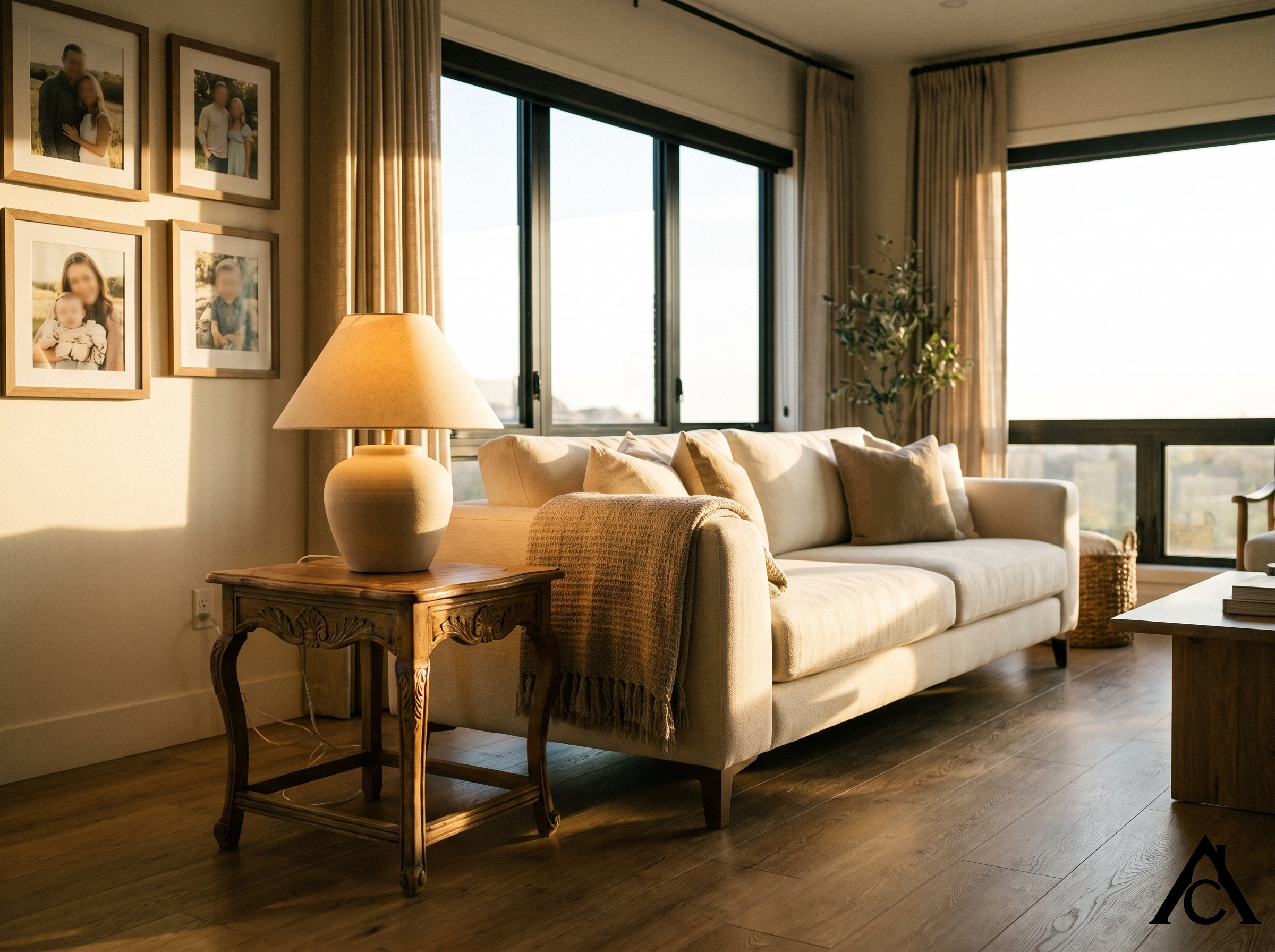
The goal of looking back is not to turn our modern homes into period museum sets or to resurrect avocado-green floral upholstery out of pure sentimentality. It is to recognize the qualities that made those remembered rooms so enduring in the first place. A truly welcoming room is not one built to satisfy an algorithm, mimic a catalog spread, or pass a real estate inspection. It is a room arranged around human habits, conversation distances, and the quiet comfort of knowing where to rest at the end of a long day.
When you anchor a space with pieces that carry genuine narrative weight — a well-loved inherited wooden table, a handmade ceramic bowl, or distinct pools of ambient lamplight — you stop staging an image and start building a home. You create a room that does not merely look pristine, but one that leaves enough gentle evidence behind to prove that your family was truly there.
