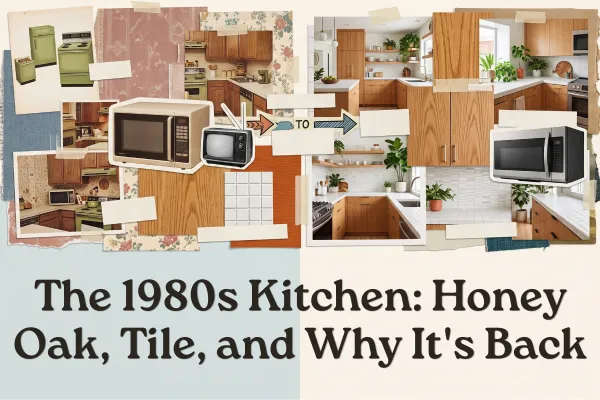
The 1980s Kitchen: Honey Oak, Tile, and Why It's Back
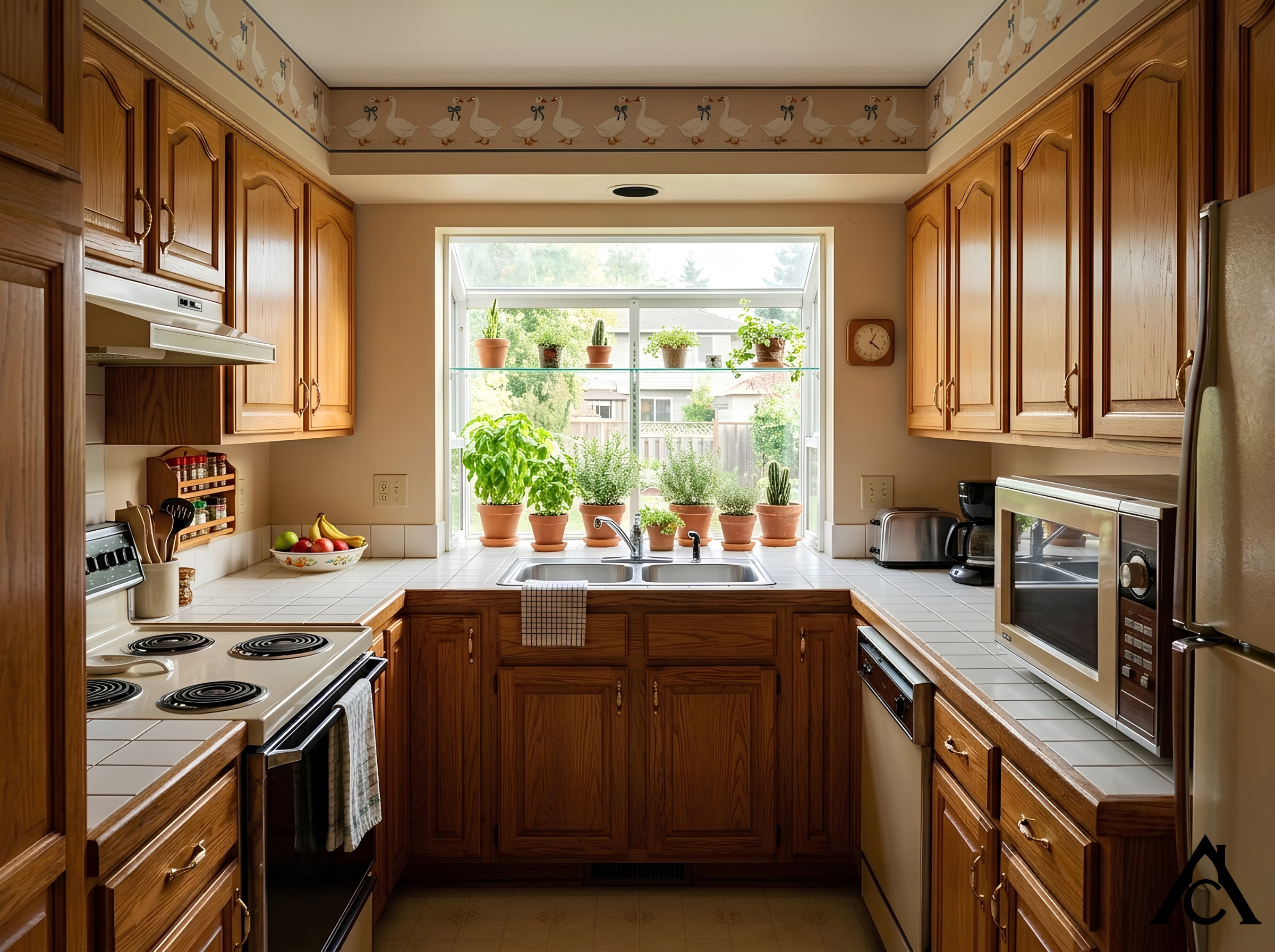
You could probably still find the light switch in the dark. It sat just past the honey oak pantry, under a wallpaper border where a line of geese in blue bows marched around the ceiling. The counter was white tile, the grout never quite white again. And the microwave, big as a television, hummed away in the corner like it was about to launch.
For a whole decade, this was the kitchen people saved up for, clipped magazine pages for, and quietly showed off to company. Then, almost as fast as it arrived, it became the kitchen everyone wanted gone.
This is the story of how one very specific room ended up in millions of American homes at the same time. It's about working parents, a beige box that changed dinner, two design camps that couldn't agree, and why, forty years later, the warm wood look is walking right back in the door.
The Kitchen Got a New Job
Here's the part most of us forget: the eighties kitchen didn't start out bright. According to the National Kitchen & Bath Association's look back at the decade, the early 1980s opened with dark wood cabinetry, lots of cherry, and plenty of raised-panel detail. Some of the seventies were still hanging around too, in harvest gold, avocado and almond. Over the next ten years, that darkness lifted in stages: deep wood gave way to honey oak, and honey oak eventually gave way to white.
The look changed because the people standing in the room had changed. In March 1980, about 56.6 percent of American women with children under 18 were in the labor force. By 1986 it was 62.8 percent, and for moms whose youngest was school-aged, it had passed 70 percent (U.S. Bureau of Labor Statistics). Two working parents, or one parent doing everything, didn't have time to baby a kitchen.
So the kitchen was redesigned around speed. NKBA points to exactly this shift, households with two earners or a single parent needing surfaces that wiped clean fast and a room that got everyone fed and out the door. That's the real reason laminate counters took over: white, ivory, and the ever-popular laminate printed to look like butcher block. It wasn't glamorous. It just worked on a Tuesday.
The industry felt the change so strongly that it launched its own awareness campaign during the decade. Kitchen + Bath Month, which NKBA marked as turning 40 in 2022, got its start in the eighties, right as the kitchen was becoming the busiest room in the house.
The Beige Box That Changed Dinner
For a lot of families, the answer to "how do we get dinner on the table faster?" arrived in a big cardboard box with a dial on the front.
The microwave wasn't new. Raytheon's first commercial oven in 1947 was nearly two meters tall and meant for restaurants. A home version followed in 1955 as a wall-mounted unit priced at $1,295, and it barely sold (IEEE Spectrum). The version that finally fit a normal kitchen came in 1967, when Amana introduced a countertop model for about $495.
The Ingenium museum collection, which holds one of those early ovens, notes that sales stayed slow until the early 1980s. Part of that was price, and part was worry: Congress passed the Radiation Control for Health and Safety Act in 1968, which set limits on how much microwave energy an oven could leak over its lifetime.
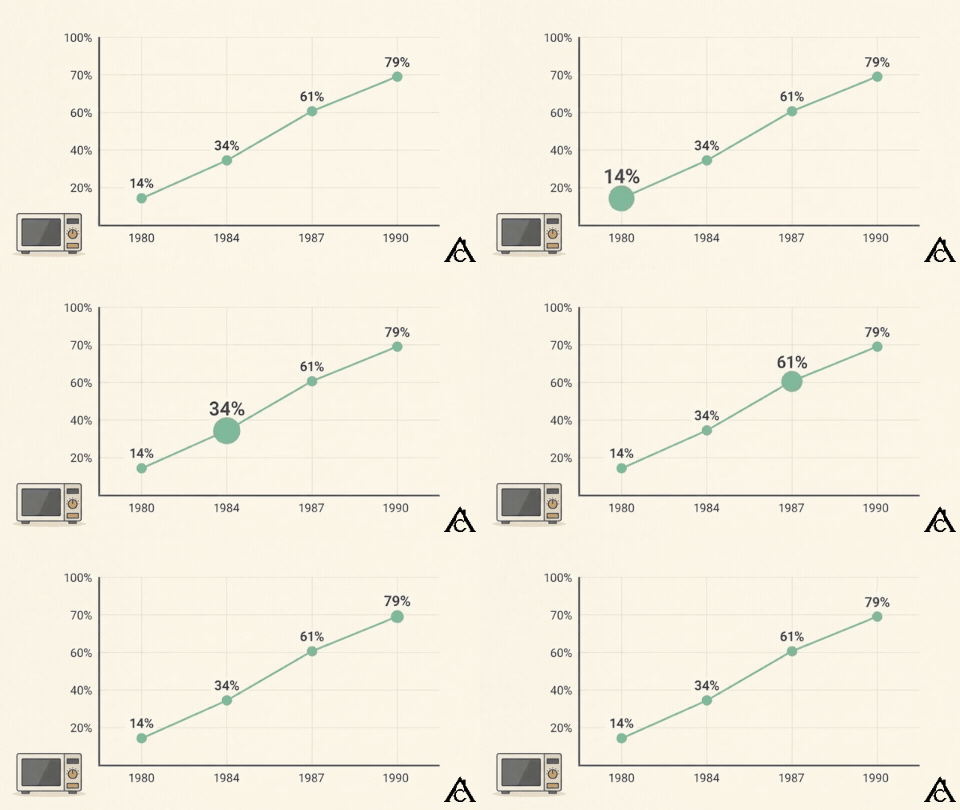
Then the eighties happened. Federal survey data from the U.S. Energy Information Administration shows how fast it moved (EIA Annual Energy Review, Table 2.6):
In 1980, only about 14 percent of households had a microwave. By 1984 it was 34 percent, by 1987 it was 61 percent, and by 1990 it had reached 79 percent.
In one decade, the microwave went from a novelty to something most homes had. By 2009, the same survey counted it in 96 percent of households, well ahead of the dishwasher's 59 percent that same year. The dishwasher was climbing in the eighties too, from 37 percent of homes in 1980 to 45 percent in 1990, but it never had the microwave's momentum.
Those early microwaves were not subtle. NKBA describes them as large and clunky, often eating up a serious stretch of counter. They were also a small declaration of independence for Generation X. Latchkey kids home before their parents learned to make their own after-school snacks and microwave popcorn (NKBA). For a lot of us, it was the first appliance we were trusted to run alone.
The microwave also opened the floodgates. Coffee makers, blenders, stand mixers, toaster ovens and electric can openers lined up along the backsplash, and all that gear had to live somewhere. That need for storage quietly shaped the rest of the decade's kitchen.
Honey Oak, Tile, and a Little Plot Twist
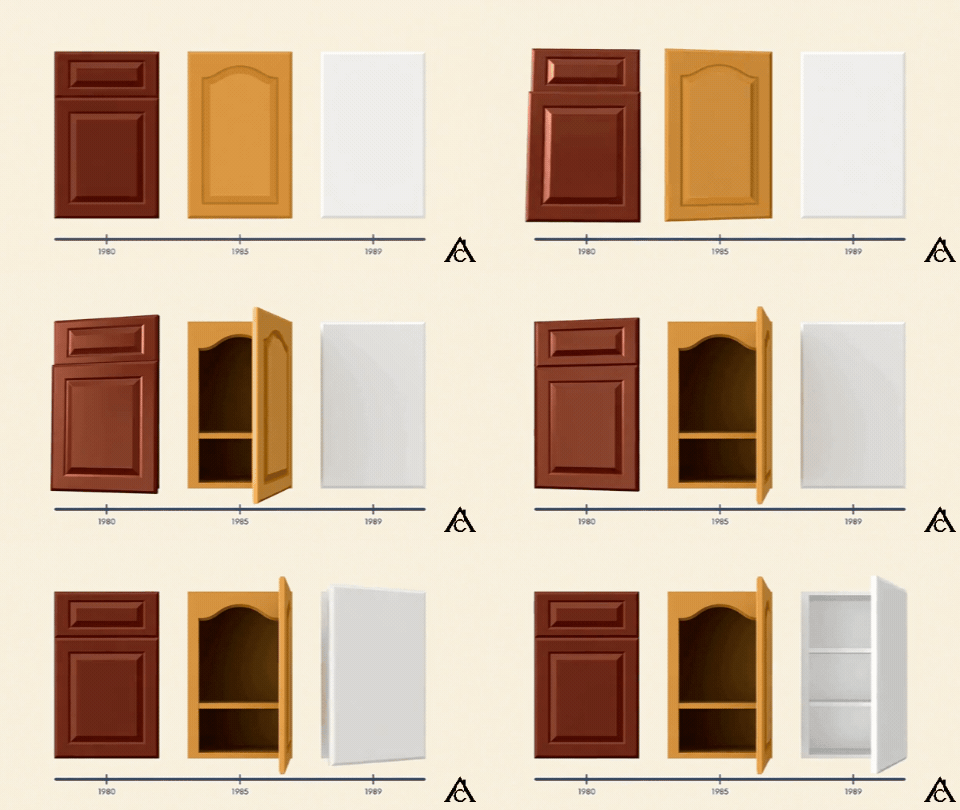
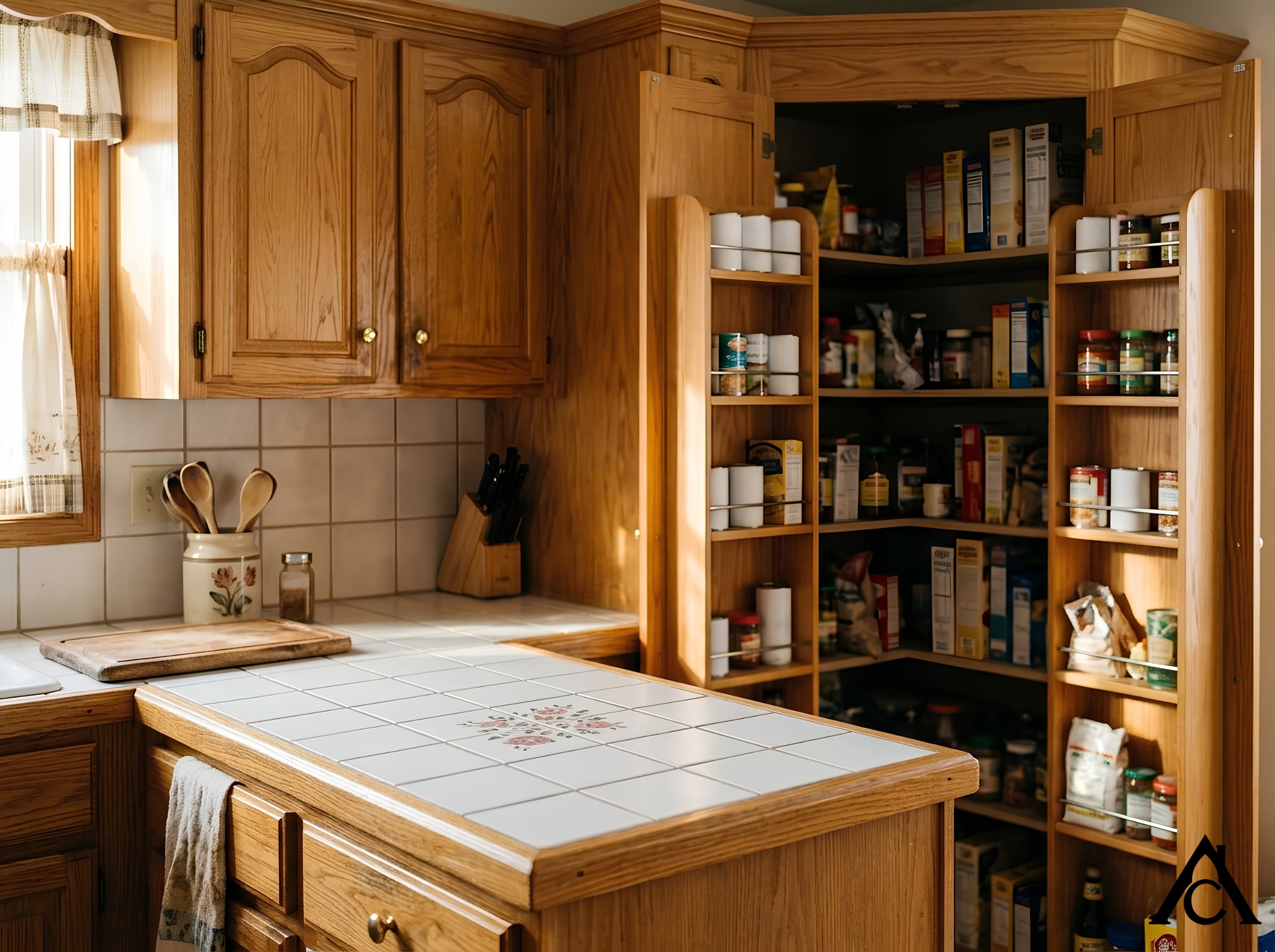
Ask anyone to picture an eighties kitchen and honey oak comes first: cathedral-arch doors, small brass knobs, and wood that glowed orange whenever the afternoon sun came through. Often the floors were oak too, so the whole room seemed to glow.
Here's the twist. A 2023 look back from the real estate news site Inman says the single most common cabinet door of the era wasn't honey oak at all. It was a vanilla-colored plastic laminate front with a thin strip of light oak along the bottom.
Honey oak with matching floors came second. Industry retrospectives from NKBA treat honey oak as the defining look, so the honest answer is probably that it depended on the budget. Laminate with an oak trim gave you the warmth for less money, and plenty of families went that route.
The same period brought a feature every eighties kid remembers: the tall pantry cabinet with fold-out shelving built into its doors, usually parked right next to the refrigerator. Opening it felt like opening a secret room full of cereal boxes.
Then there was the tile. In one of the decade's odder moves, ceramic tile climbed down off the backsplash and took over the countertop itself (NKBA). Square white tile matched honey oak beautifully, and some of it came with little painted florals or geometric prints.
What nobody mentioned in the showroom was the grout. Every rolling pin and every cutting board met a bumpy surface, and a lot of weekend afternoons went into scrubbing those lines with an old toothbrush.
Underfoot, the old sheet linoleum started to come up. In many new kitchens, especially later in the decade, white tile went down in its place.
Country or European? Two Kitchens, One Decade
By the middle of the decade, two very different ideas were fighting over the same room.
The country kitchen
The first was country, and it arrived with its own magazine. In July 1980, The Christian Science Monitor reported that Country Living had reached a circulation of half a million only about sixteen months after launch. Its readers were young, averaging 34 years old, and they wanted to know everything about country kitchens, country cooking and country houses. That same summer, Mary Ellisor Emmerling, author of the style guide American Country, opened an American Country Store in Southampton, New York, selling cupboards, twig tables, rag rugs and weather vanes to people chasing the look.
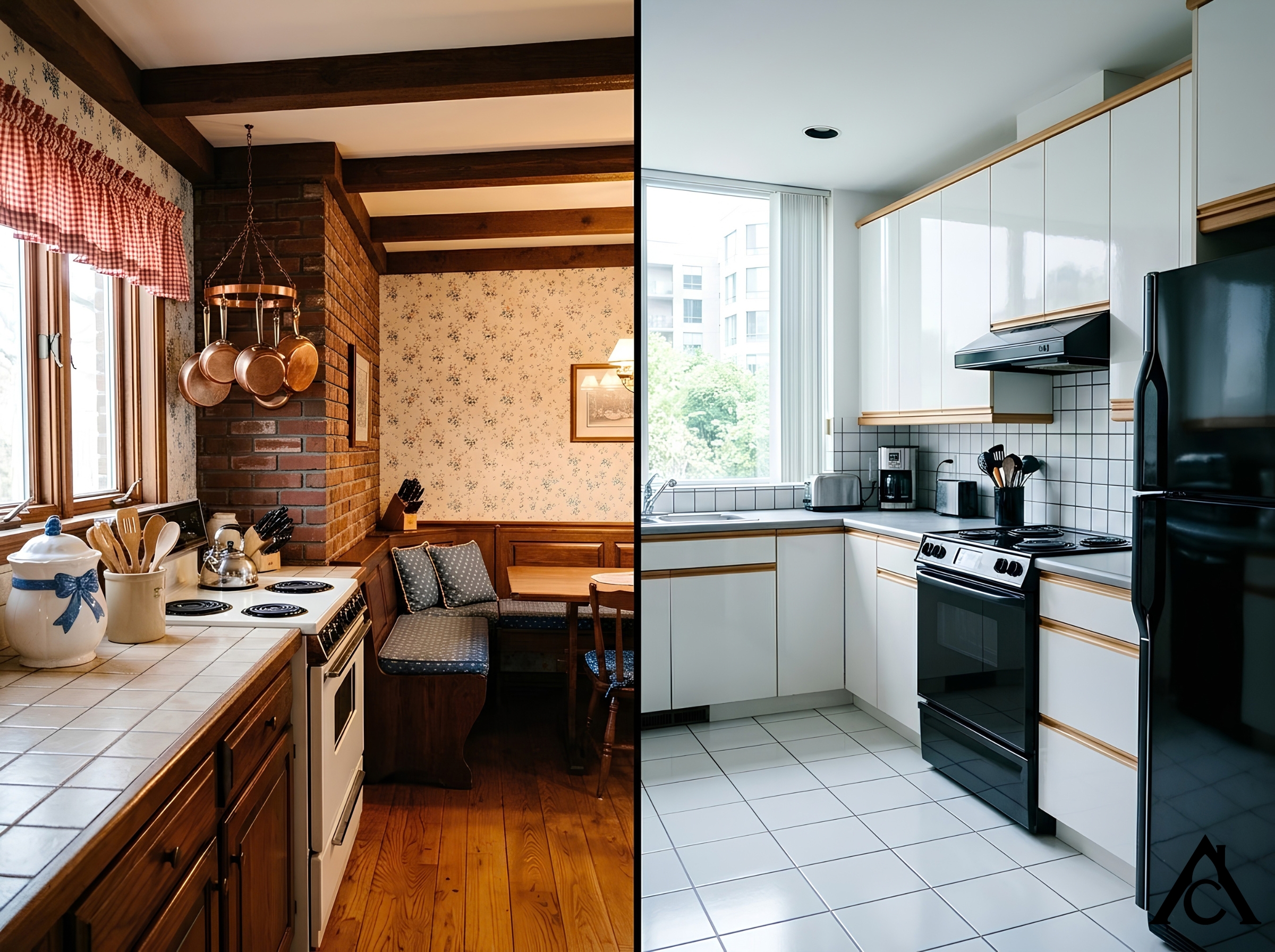
A country kitchen meant exposed beams, a built-in banquette, floral wallpaper, and a little café curtain over the sink (NKBA). Higher-end versions added a whole wall of brick or a tiled range hood (Inman). Then came the accessories: ceramic geese in blue bows, ducks, roosters and hearts, on canisters, towels, plates and wallpaper borders (Hunker). Handy homeowners picked up stencil brushes and painted folk-art patterns onto furniture and even straight across the floor, a detail that Country Living's own editor now counts among the eighties ideas quietly coming back.
The European kitchen
The other camp wanted none of that. European-style cabinetry brought flat white slab doors, sometimes glossy, often edged in a thin strip of wood. Some skipped hardware completely, using push-to-open latches or a hidden finger groove, a look NKBA calls a precursor to today's seamless, handleless kitchens.
Appliances followed the same split. The seventies' harvest gold and avocado faded out, and white took over, with black or bisque as the alternatives. Glossy black was the futuristic choice of the decade, the kind of fridge that looked like it belonged on a spaceship (NKBA). Stainless steel, the finish we now think of as standard, was still years away from the mainstream.
What's interesting is that both camps were answering the same need. Country promised comfort in a decade that moved fast. European promised order and easy cleaning. Most real kitchens ended up somewhere in between: a white laminate cabinet with oak trim, and a goose canister on the counter anyway.
Light, Glass, and the Birth of the Island
If the seventies kitchen was a little dim, the eighties kitchen went looking for light.
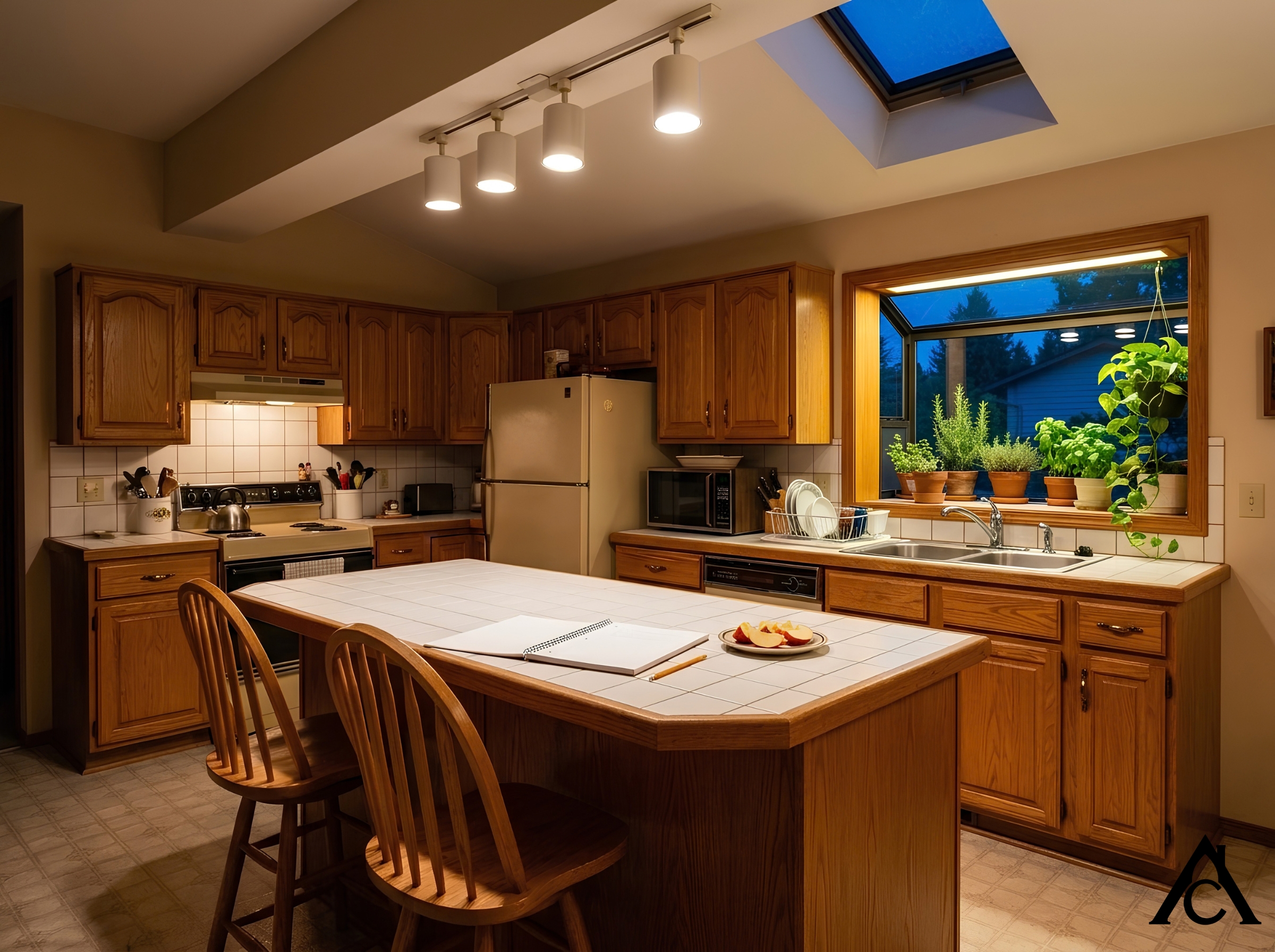
First to go was the big fluorescent box overhead, the one that buzzed and flickered and turned everyone's skin slightly green. Track lighting replaced it as the sleek, modern alternative, a row of little spotlights on a ceiling rail, each aimed at something slightly different (NKBA).
New builds added skylights, and having one directly over the kitchen was the ultimate bragging right. Ceiling fans came with their own light kits, spinning over breakfast nooks just fast enough to rearrange the napkins.
Then there was the greenhouse window. Suburban homeowners were wild about them: a glass box that bumped out past the wall above the sink, with glass shelves for herbs, pothos and the odd cactus. NKBA points out a practical side effect. Standing at the sink every night made it hard to forget to water the plants.
The floor plan was changing too. According to NKBA, layouts stretched into U-shapes with bigger pantries, peninsulas and, eventually, islands. Islands wouldn't truly take off until the nineties, but they were born here. Add a couple of barstools and the kitchen became the homework desk, the snack bar and the place where every family announcement got made.
All those new cabinets had a very specific job. The eighties were a decade of buying things, and the cookware, fondue pots, woks, food processors and gadgets needed a home. In many houses, though, the peninsula did the island's job: a counter jutting out from the cabinet run, half-dividing the kitchen from the dining area. It was a room that wanted to be open but wasn't quite ready yet.
By the late eighties, granite started showing up in the most ambitious kitchens. It was expensive, limited in color, and early slabs were known to chip and crack (NKBA). Granite's real moment would come later, once stone processing caught up.
Then It Erased Itself
The strangest thing about the eighties kitchen is that the decade dismantled it before the decade was even over.
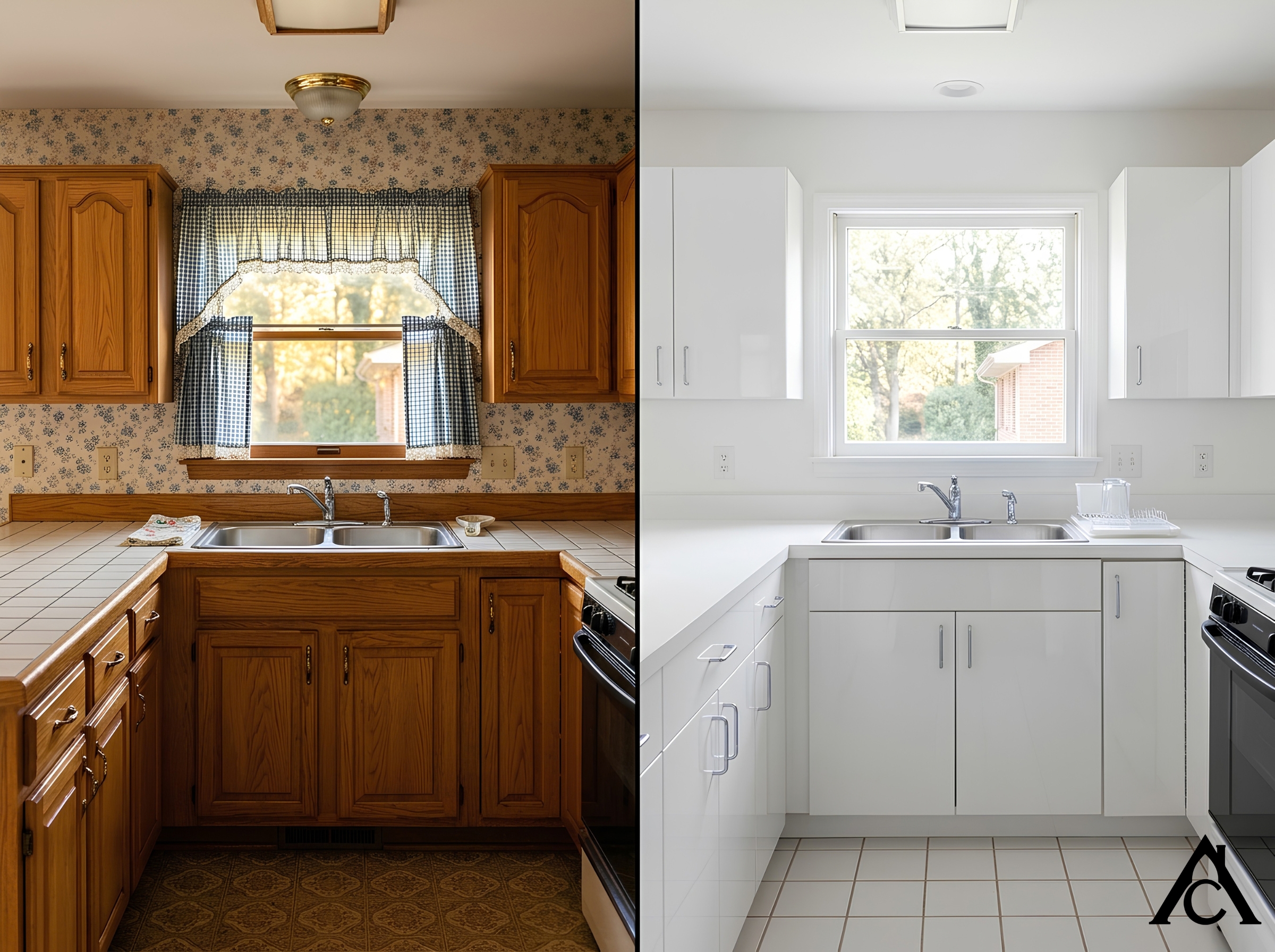
By the late 1980s, the gleaming all-white kitchen was making a comeback, a look that had been popular before and after World War II (NKBA). The wallpaper came down. So did the little curtains over the sink. Countertops went white, floors went white, and new kitchens took on an almost clinical cleanliness. The honey oak that had defined the middle of the decade suddenly looked like the past.
What followed was a long stretch where warm wood was the thing you painted over, not the thing you showed off. Painted cabinets came to dominate, at one point reportedly accounting for as much as 70 percent of the market (Woodworking Network).
For anyone who grew up in the nineties and 2000s, honey oak started to read as a sign that a house needed updating. Apartment Therapy draws the line clearly, contrasting today's softer white oak with the high-gloss orange oak so many of us grew up with.
It's worth pausing on that distinction, because it matters for what comes next. People didn't fall out of love with wood. They fell out of love with one particular stain.
Forty Years Later
Design runs in cycles, and Country Living's editor-in-chief puts that cycle at roughly forty years (Country Living). Count forty years forward from the middle of the eighties, and you land right about now.
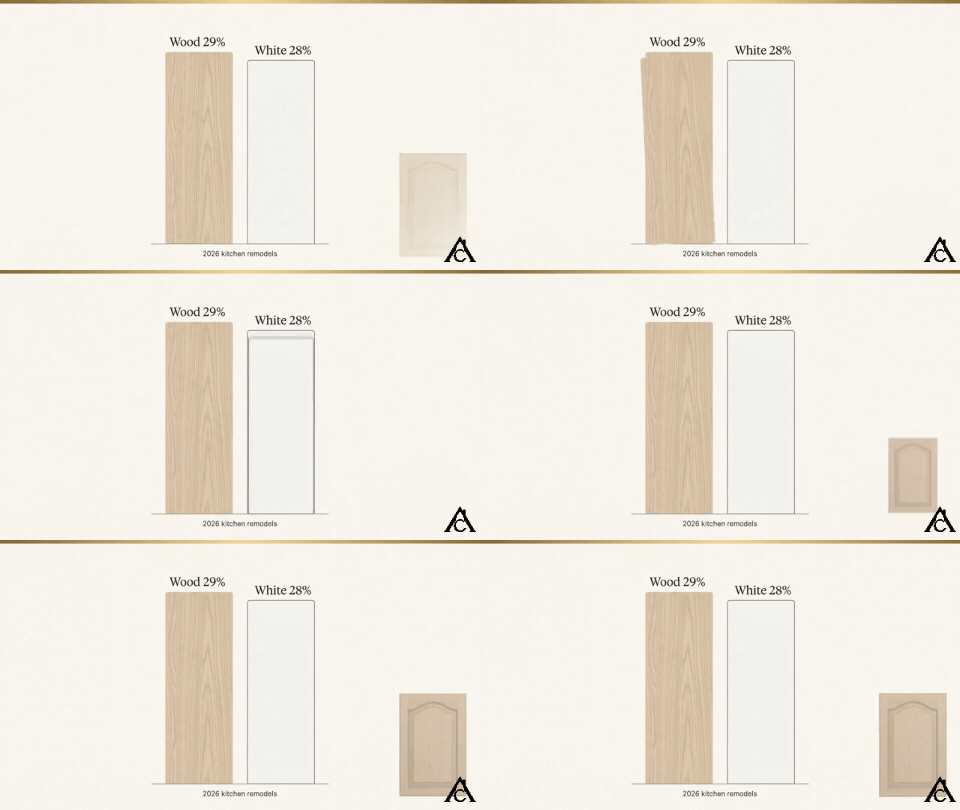
The numbers back it up. In Houzz's 2026 Kitchen Trends Study of more than 1,700 renovating homeowners, wood cabinets edged out white for the top spot for the first time in years: 29 percent to 28 percent. Wood jumped six points in a single year while white slipped five (National Association of Realtors).
Medium wood tones led the way, ahead of light and dark finishes. Nearly a quarter of homeowners chose a two-tone kitchen, and when they did, wood was the most popular pick for the lower cabinets.
The professionals see it too. In the National Kitchen & Bath Association's 2026 Kitchen Trends Report, 59 percent of industry respondents said wood grain is growing in popularity, overtaking painted cabinets, and white oak was the most popular species at 51 percent. The same survey found 96 percent naming neutrals as the most popular kitchen colors, with greens and blues close behind.
One caution for accuracy's sake: not everyone reads the data the same way. Woodworking Network points out that when you count every painted color together, paint still holds about half the market. Wood hasn't won; it has stopped losing.
And today's wood isn't the wood of 1985. White oak leads with softer, ashier undertones, simpler flat or slim doors, and matte finishes instead of gloss. It carries the warmth people loved about the eighties without the orange glow. Even stenciling is getting a second look, on floors and painted furniture, just with a lot fewer geese.
Keep the Bones
If you're living with an eighties kitchen right now, or you're about to list a house that has one, this is the good news: you may not need to tear it out.
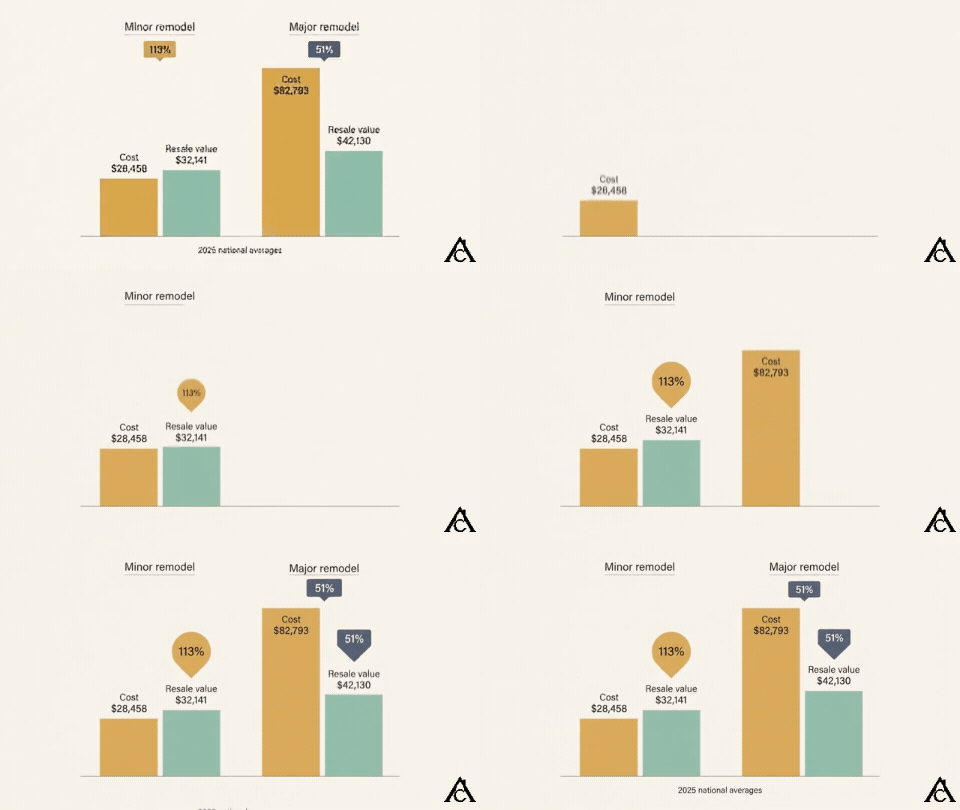
The 2025 Cost vs. Value Report from the Journal of Light Construction tracks what remodeling projects cost against what they add at resale. Nationally, a midrange minor kitchen remodel averaged $28,458 and added about $32,141 in resale value, recouping roughly 113 percent of its cost. A midrange major remodel averaged $82,793 and recouped only about 51 percent.
The minor version keeps the layout and updates the surfaces: refinished cabinets, new counters and flooring, and a couple of appliances (NerdWallet). These are national averages built from estimates, and they swing widely by region and from year to year. In the 2020 edition of the same report, that minor remodel recouped 78 percent.
That math fits the eighties kitchen unusually well, because the layouts were often practical and solid wood cabinet boxes can take a new finish. The kitchen that made honey oak famous may be the easiest one to bring into 2026, and the most personal.
Picture it the way the eighties would have, just with a lighter hand. The oak stays, but if it's solid, a professional refinish in a softer, cooler tone brings it remarkably close to today's white oak (Apartment Therapy). The brass pulls come back in slimmer shapes, or give way to plain wooden knobs. The grout-line counters finally retire, and a butcher-block island top picks up the warmth instead; Houzz found wood gaining ground as an island countertop (NAR).
The greenhouse window lives on as a simple row of potted herbs on a shelf over the sink. The track lights become warm, dimmable pendants. And one goose canister is allowed to stay. Just one, somewhere it makes you smile.
If you're staging to sell, that same warmth can help. Real estate coverage of the Houzz findings notes that wood cabinets can make a listing feel current rather than dated (Florida Realtors), especially when the rest of the room is calm and uncluttered.
The Room Where Everyone Ended Up
Underneath the honey oak and the grout lines, the 1980s kitchen was really a story about a family with less time and more to juggle, and a room that stretched to hold all of it. It fed people faster, it held the homework and the bills and the news, and somehow everyone always ended up standing around the counter. The styles changed, then changed again, but that feeling of a kitchen that knows your family is the part worth keeping. If your own kitchen still has a little of that eighties warmth in it, you're closer to the look everyone wants now than you might think.
