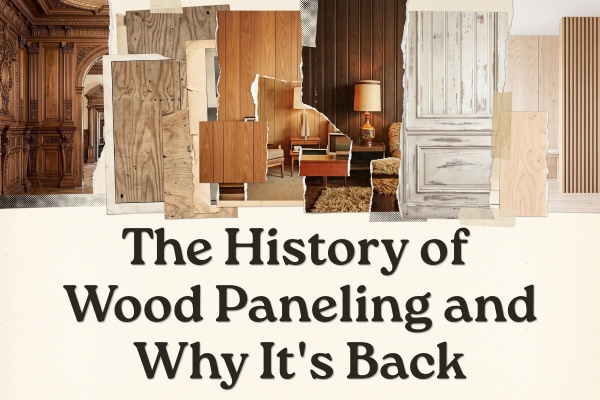
The History of Wood Paneling and Why It's Back
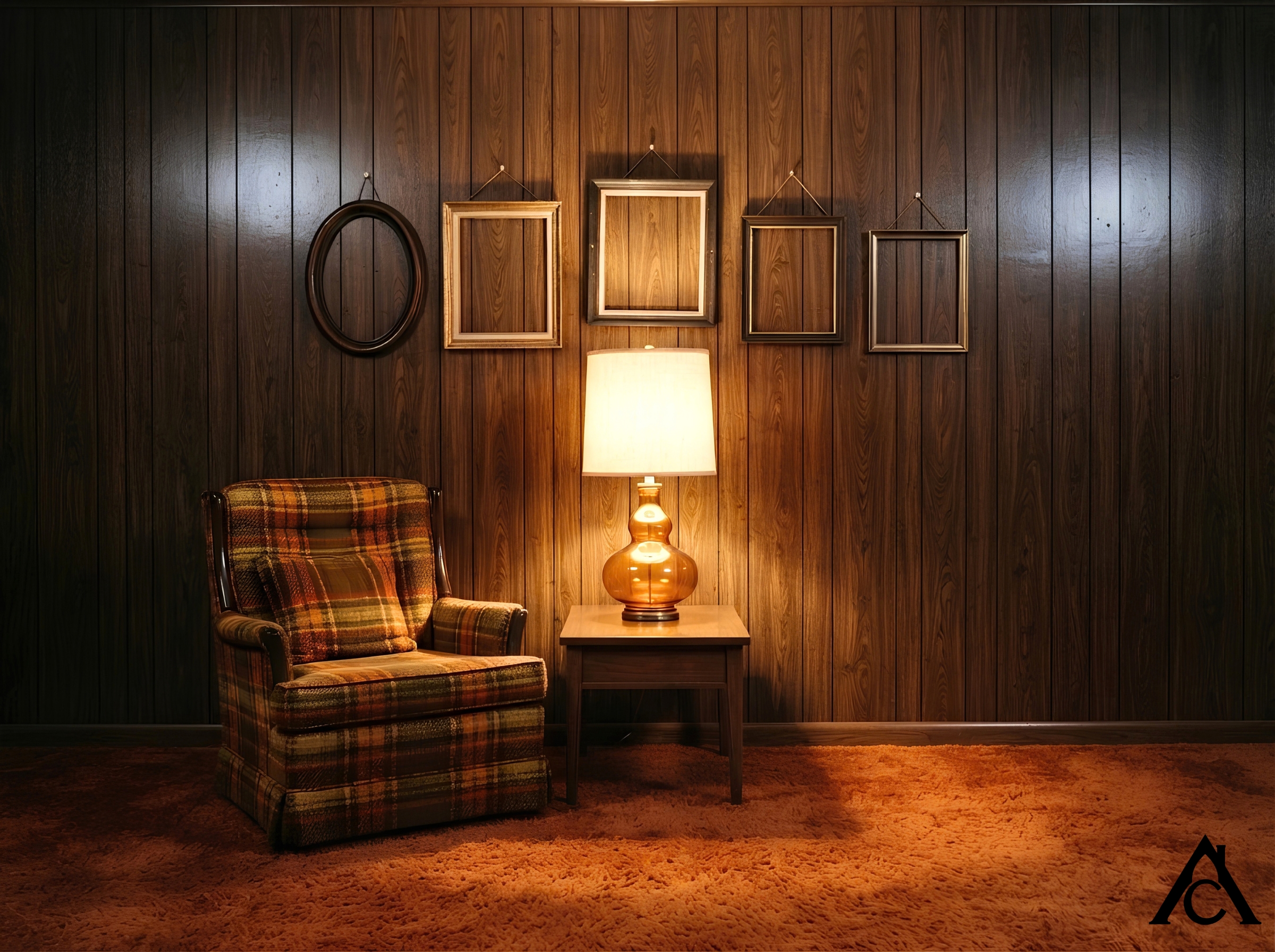
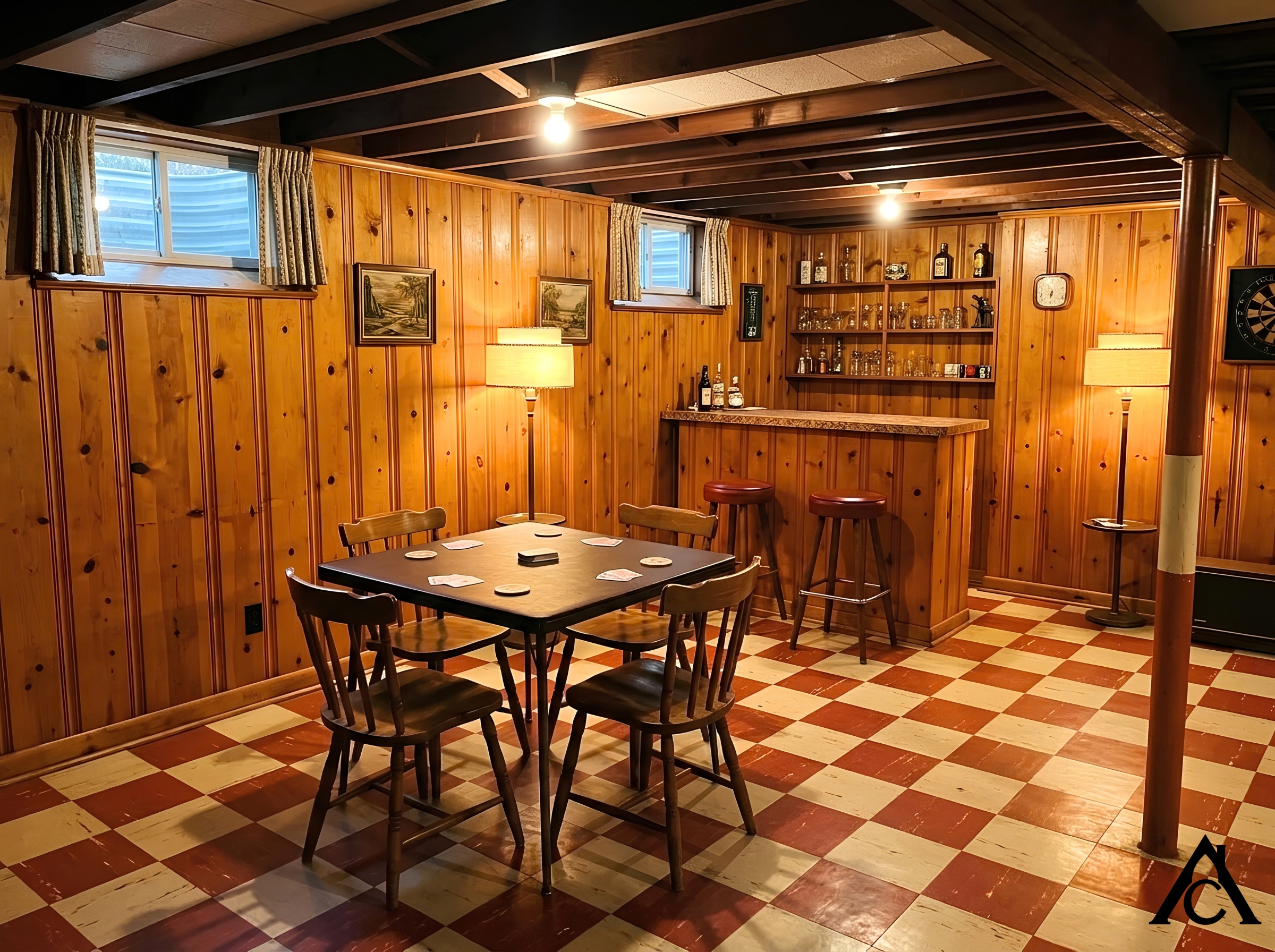
If you grew up in a house built somewhere between the fifties and the seventies, you may remember a wall that sounded hollow when you knocked on it. Dark brown. A little shiny. Thin grooves running floor to ceiling, as if somebody had drawn the boards on with a ruler.
Nobody in the family chose that wall the way you'd choose a sofa. It was just there, in the den, down the hallway, and absolutely in the basement, holding up the school photos. So here's the question this post is about: how did one kind of wall end up in so many houses at once? The short answer is carved oak, glue, a world war, a great many cargo ships, and a price that fell by almost half.
Before It Was Cheap, It Was Fancy
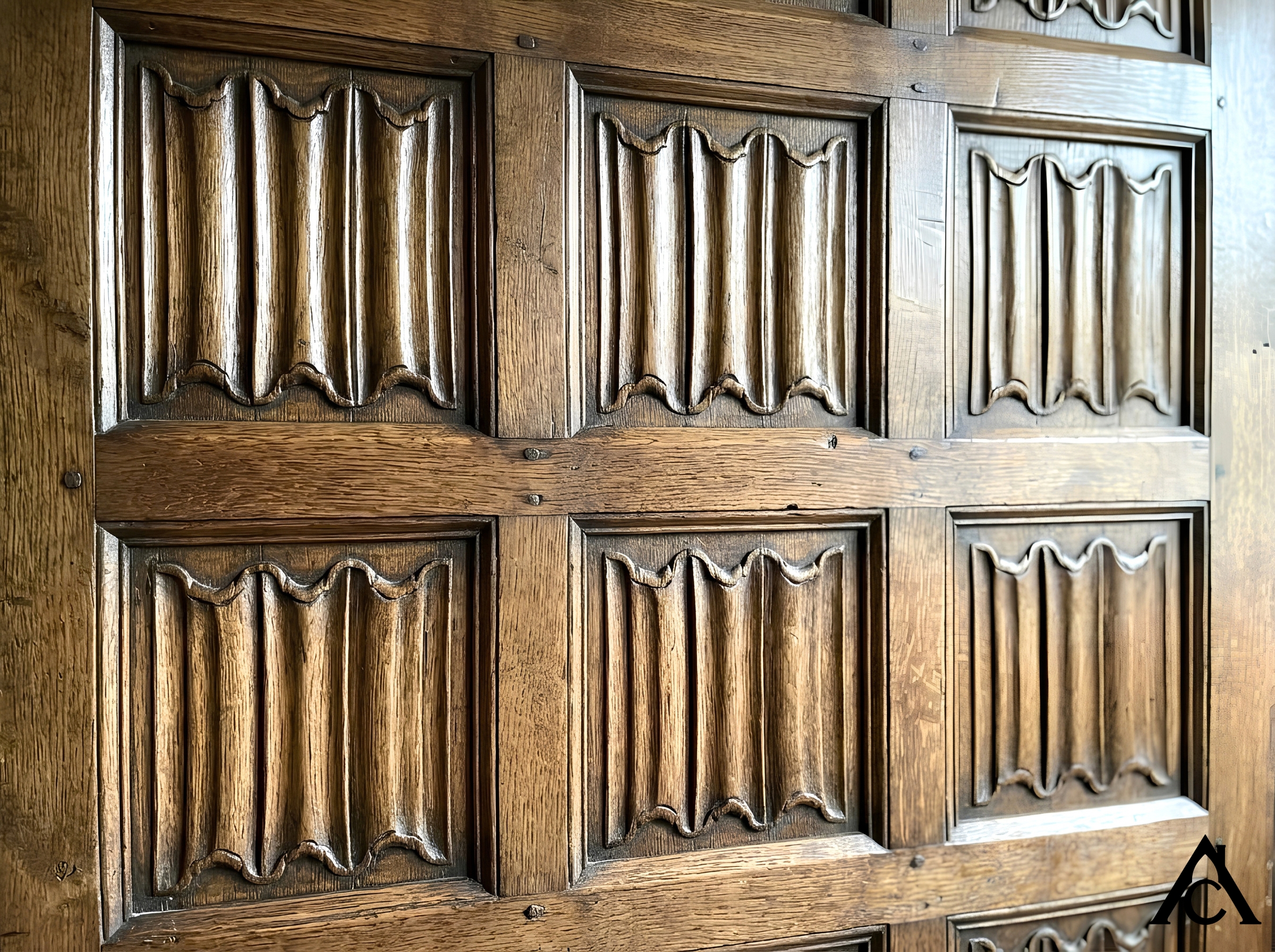
Wood on the walls is very old. Britannica traces its wide use on walls and furniture to the Gothic period, and calls rich wood paneling one of the signatures of Tudor and Elizabethan England. The construction even has its own vocabulary: the thin sheets are panels, the upright strips that frame them are stiles and muntins, and the horizontal ones are rails. In early English Renaissance mansions, oak paneling ran eight or ten feet up the wall, and the oak itself was traditionally imported from Russia, Germany, or Holland.
Then the carvers got involved. The Victoria and Albert Museum holds panels cut with a pattern called linenfold, rows of little wooden pleats that look like draped cloth. It was common across Northern Europe from about the mid-1400s, worked into thin quarter-sawn oak with molding planes and finished with a chisel. In the France of Louis XIV and Louis XV, paneling turned lavish. The Metropolitan Museum's Varengeville Room, made for a Paris townhouse around 1736 to 1752, is oak that has been carved, painted, and gilded.
America started plainer. In seventeenth-century New England, paneling went up without decoration; in the 1700s it got fancier, especially in the Southern colonies. Either way, it was almost always oak or pine, and it was worked by hand.
By the twentieth century, an old paneled room was something a museum would buy whole. In 1923 the Museum of Fine Arts in Boston bought a complete linenfold room said to have come out of an English rectory. Later research showed it was really an assemblage of mostly Tudor pieces put together by a London antiques firm. Real or assembled, it was worth collecting.
The Sheet That Changed the Math
What changed everything wasn't a style. It was a material.
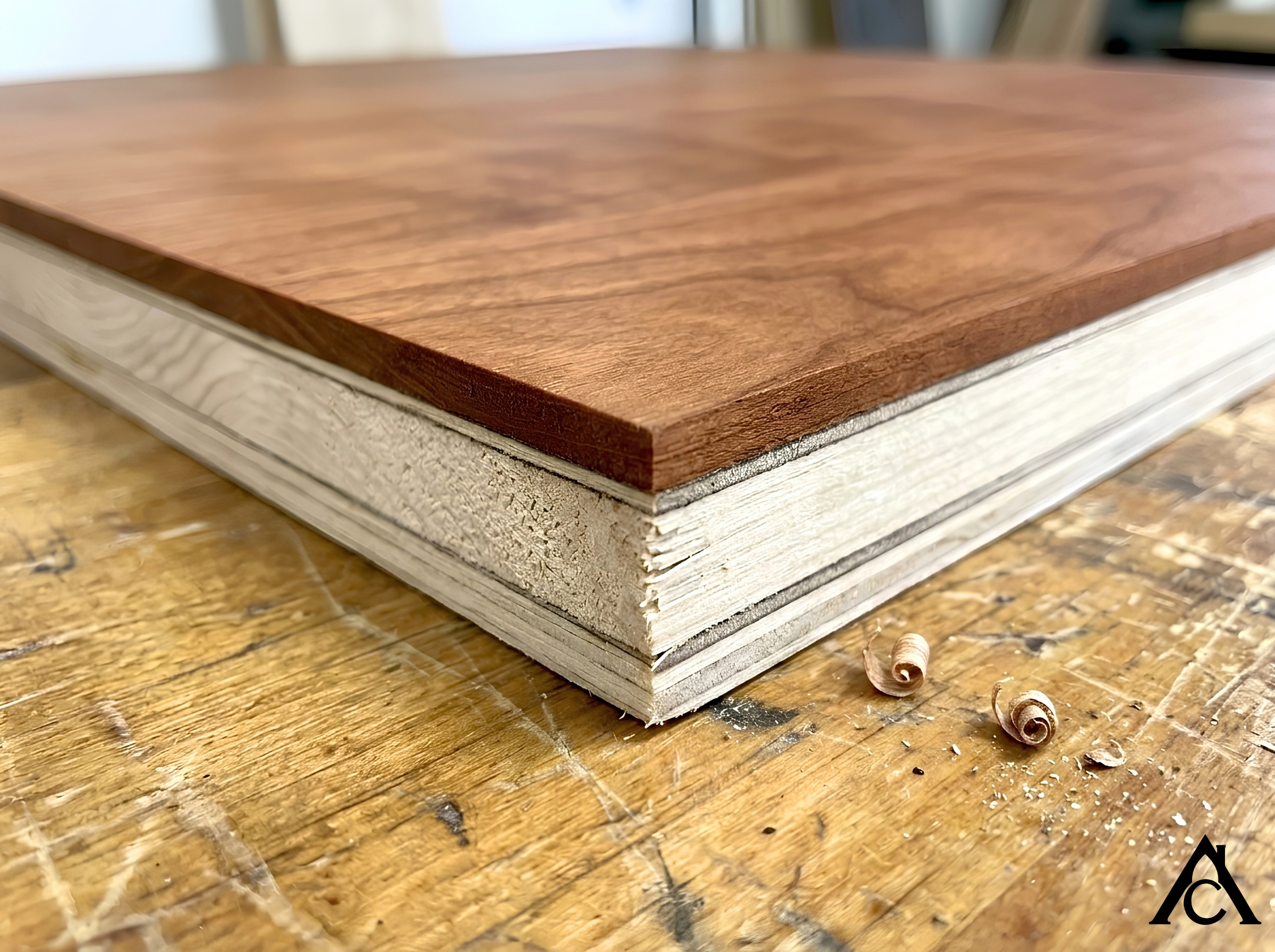
Plywood is thin sheets of wood glued together, with the grain of each layer running crosswise to the one beneath it. That crisscross is the whole trick: it's what makes the sheet stronger than ordinary lumber and slow to warp. The idea had been kicking around for a long time. In 1867, somebody exhibited a 107-foot elevated railway tube made of molded plywood at a fair in New York. During the Depression, the U.S. Forest Products Laboratory published plans for an all-wood house that could be built in a factory from standard plywood panels.
Then came the war. According to the plywood industry's own history, the material was used heavily in military boats, aircraft, barracks, and crates. By 1944 the architecture journal Pencil Points was announcing that "Plywood's future has begun," and reporting a speech by the head of U.S. Plywood, who predicted plywood bathtubs, feather-light molded car bodies, and factory-built homes with movable walls.
Whatever became of the bathtubs, plywood did find its way onto the wall. A wall no longer had to be built board by board. It could arrive as one big sheet, and a single thin slice of handsome wood on its face could make the whole thing look like money.
A Country Full of New Homeowners
Meanwhile, America was buying houses.
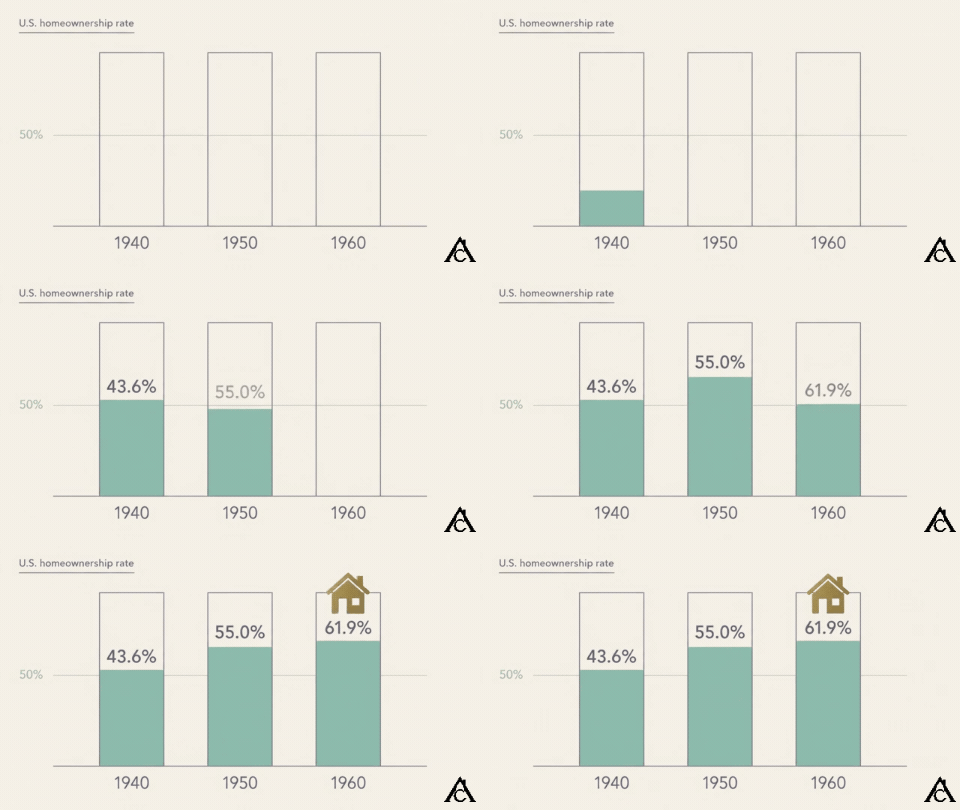
The Depression had pushed homeownership to its lowest point of the century: about 44 percent of households in 1940. The Census Bureau credits what happened next to a booming economy, friendly tax laws, a revived building industry, and easier financing. By 1960 the rate was 61.9 percent. A recent Federal Reserve analysis calls that stretch the largest change in American homeownership in the past hundred years.
Not all of those owners moved into something new, either. According to one economist's study, a special tabulation of the 1950 census suggested that roughly three million homes that were owner-occupied in 1950 had been rentals in 1940.
So picture millions of people who suddenly owned their walls, and had opinions about them.
They also had skills. When the National Building Museum mounted its exhibition Do It Yourself, its curator credited the war with getting both men and women used to working with tools and machinery. Magazines had been cheering on weekend projects for years, including, yes, paneling the attic.
Paneling a rec room wasn't a new idea, either. A 1937 photograph in the Grand Rapids Public Library's collection shows a basement recreation room with two wood-paneled walls and a beamed ceiling. And an old favorite, wherever it went, was knotty pine: real boards, warm and golden, every knot left showing.
In December 1960 the Ann Arbor News ran a feature on a local house with knotty pine in the family room, set off by a raised brick hearth, and more knotty pine downstairs in a rec room with a built-in bar. Paneling had become the thing you did to a room to make it officially cozy.
The Price Tag Nobody Remembers
Here's the part of the story that rarely gets told, and it comes from a 1965 U.S. Forest Service report with the unglamorous title U.S. Hardwood Imports Grow as World Supplies Expand.
Before the war, America exported more hardwood than it imported. Afterward, that flipped. In 1953, Japanese plywood makers launched their first big sales drive into the American market. Their mills were peeling a reddish tropical wood called lauan, shipped in as logs from the Philippines and Borneo, into thin, smooth sheets.
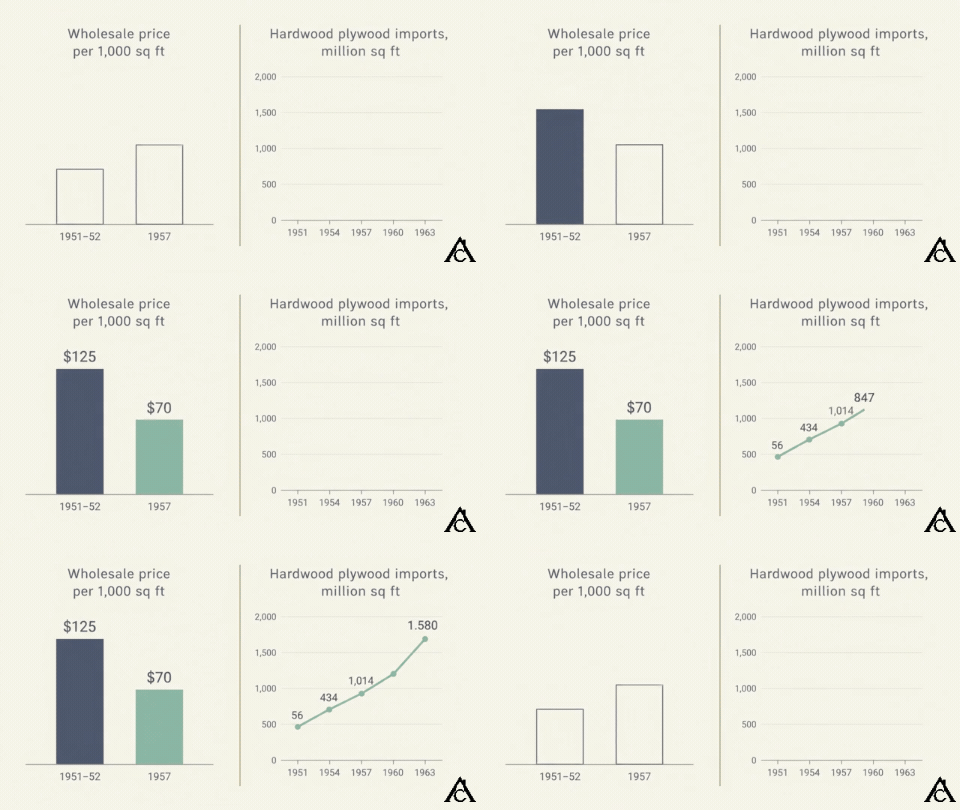
Then the price fell. The wholesale price of imported hardwood plywood went from around $125 per thousand square feet in 1951 and 1952 to about $70 by 1957, and it stayed there into the sixties. Japan led the way down: in 1957 it cut its price to $65 while sheets from other countries were still priced at $110, and the other exporters soon followed.
All of this happened despite a 20 percent tariff. Imports grew from 56 million square feet in 1951 to 1.58 billion in 1963. By 1957 the country was importing more hardwood plywood than it made, and by the time the report was written, imports were 60 percent of all the hardwood plywood Americans used.
The Forest Service made the connection directly. Cheap imports, it wrote, had helped create two major new markets: flush doors and interior paneling. The door half of that is easy to forget. Output of flat, smooth flush doors went from a few hundred thousand a year in 1947 to more than 15 million by 1958, nearly wiping out the traditional panel door. The paneling half is the wall you grew up with. Hardwood plywood, the report said, was making significant gains on plaster, drywall, and even good old knotty pine.
Not everybody was happy. America's own hardwood plywood industry was small, about 130 plants and 15,000 workers. The U.S. Tariff Commission found that 40 percent of the companies that submitted records had operated at a loss in 1954. Nearly fifty bills to limit foreign wood were introduced in Congress within a decade, and the industry's requests for protection were turned down in 1955 and again in 1959. By the early sixties Japan's share of those imports had shrunk to 45 percent, as Taiwan, the Philippines, and South Korea moved in.
And about that reddish wood. Sellers called lauan "Philippine mahogany." Botanically, it isn't mahogany at all. The real-mahogany trade had been fighting the name since the 1920s, and a federal appeals court let it stand anyway, remarking that the purchasing public "knows little, and cares less" about the botany.
The plywood makers were happy to brag. A 1955 advertisement for one brand claimed that more than 60 percent of buyers in one large West Coast development said paneling had helped them decide. That's an ad, not a survey, so take the number with a grain of salt. In California, the builder Joseph Eichler lined his modern houses with Philippine mahogany from the 1950s into the early 1970s: living and dining areas, hallways, even bedrooms and kitchens. His longtime construction foreman put it simply: "Joe Eichler really loved that wood paneling."
Peak Paneling
After that, it only got easier. By 1965 the Forest Service was noting that Asian mills had been shipping panels prefinished for several years, so the staining was done for you. Some were "printed" as well. The report doesn't define the word, but it almost certainly means what it sounds like: a wood-grain pattern printed onto the face. A 1961 plywood ad showed off what one weekend of do-it-yourself work could do to a room. Nail it up Saturday, hang the photos back up Sunday.
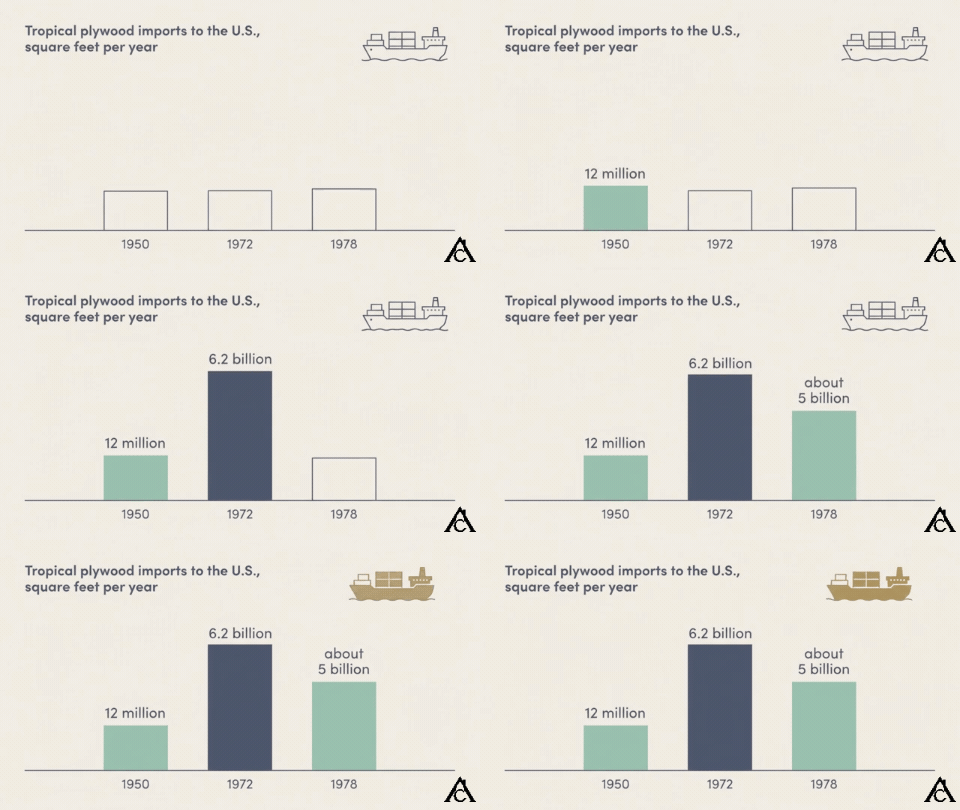
The numbers at the top are hard to picture. According to a United Nations forestry review, imports of tropical plywood alone peaked in 1972 at nearly 6.2 billion square feet in a single year. By the same count, the 1950 figure had been about 12 million. (That's a narrower measure than the Forest Service numbers above, which cover all hardwood plywood, so the two sets don't line up exactly.) In that peak year, tropical wood made up 58 percent of all the hardwood plywood Americans used.
Not every sheet went on a den wall. Plenty became doors and cabinets, and a great deal went into mobile homes, which factories were shipping at a rate of about 580,000 a year by 1973. But walls got a lot of it: a Forest Service study of the Michigan and Wisconsin mills in the late sixties found that wall paneling was their biggest market, with door skins second. And wood grain itself had escaped the house by then, turning up as vinyl down the side of the family station wagon.
How the Wall Wore Out Its Welcome
And then the climb stopped.
Imports dropped sharply in the mid-seventies. They bounced back by 1978, and then prices jumped and homegrown particleboard started taking plywood's place. A later Forest Service review summed up the era plainly: after 1970, hardwood plywood imports went down.
There was a health worry, too. The glues in some pressed-wood products gave off formaldehyde, and the EPA still includes hardwood plywood paneling made with urea-formaldehyde glue among the pressed-wood products it calls the most likely significant sources of formaldehyde in a home. In August 1984, federal housing officials set emission limits for the plywood and particleboard used in manufactured homes, and required a health notice in every one.
Emissions came down as well. The Consumer Product Safety Commission says emissions from pressed-wood products have been reduced 80 to 90 percent from their levels in the 1980s and earlier, and today's federal rules cap formaldehyde emissions from hardwood plywood in manufactured homes at 0.05 parts per million.
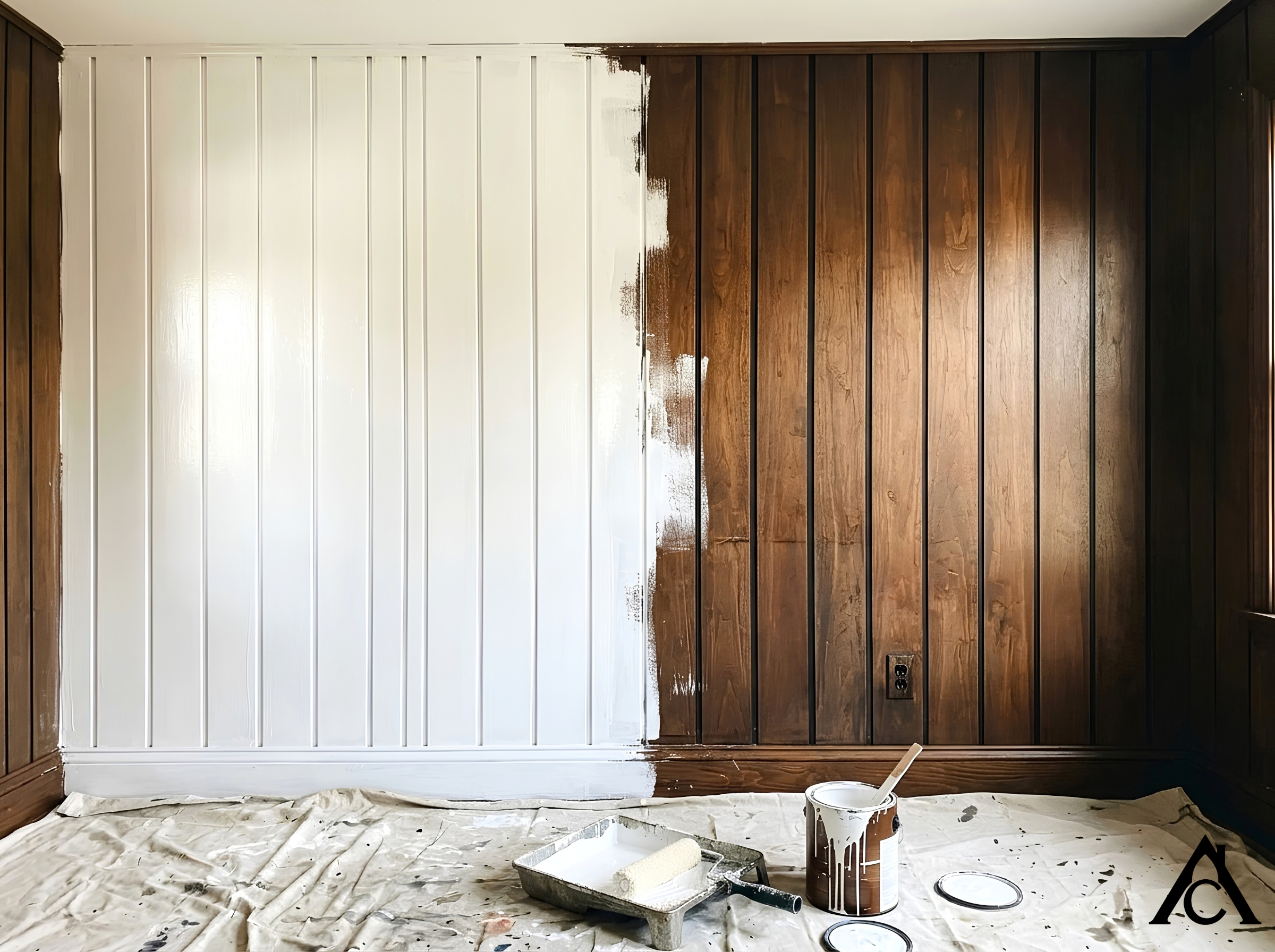
And taste was leaving the room anyway. The eighties wanted pastels, glass block, and a lot less brown. One Apartment Therapy writer remembers her parents painting their 1970s basement paneling white to drag the house into the nineties. Somewhere along the way, "wood paneling" started to sound like shorthand for a house that needed work.
Round Two
Here's the twist. Wood walls are back.
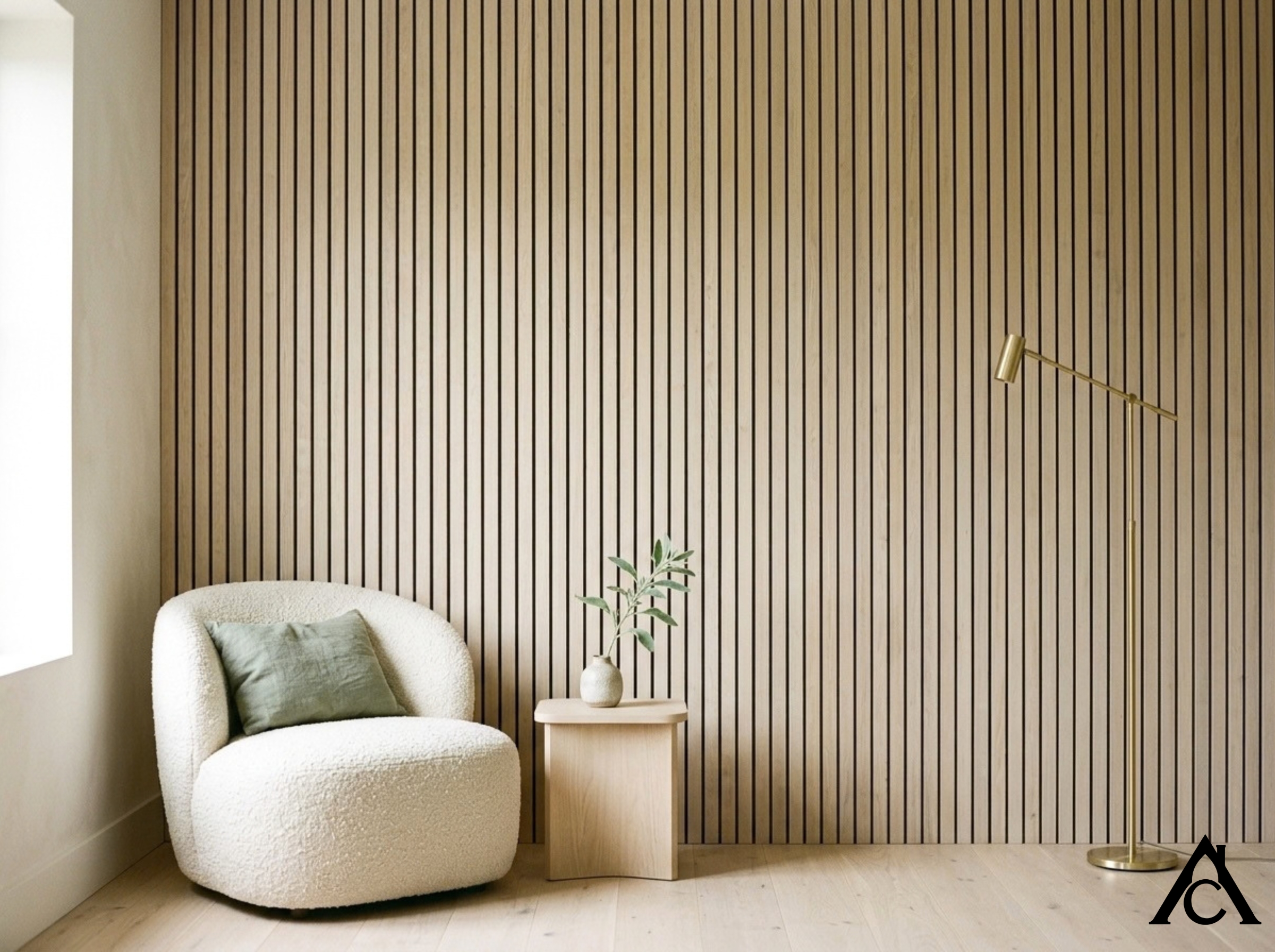
When The Spruce asked designers which looks were returning in 2026, wood paneling made the list, with talk of fluted walls, tongue-and-groove ceilings, and stained oak. "We're swinging away from stark white everything," one designer said, "and back into warmth and architectural soul, and paneling gives that instantly." Houzz has a name for going all in: wood drenching, where floors, ceilings, and built-ins are all clad in the same wood.
The difference this time is that it's lighter, often white oak, and slimmer. Back in 2022, Domino was already calling slatted wood "the texture of the moment"; the 2026 version leans toward fluted panels and plank ceilings. Either way, it's a long way from wide grooved sheets on all four walls.
Buyers seem to be in the mood for it. Zillow's new Buzz Index, built from more than two million 2025 listings, found that homes with exposed beams draw about 20 percent more daily engagement, vintage features about 14 percent, and midcentury homes about 13. To be fair, Zillow didn't measure wood paneling itself. What it measured is appetite for character, and that, funnily enough, is exactly what the old paneled den was trying to offer.
If the Wall Is Still in Your House
If you're living with one of these rooms right now, the first thing worth knowing is which wall you actually have. Solid boards, like knotty pine, are real wood all the way through, and they deserve a long look before anyone covers them up. A thin sheet with a slice of real veneer on top is still wood where it counts. A thin sheet with a printed pattern is a different story.
If you decide to paint, the standard advice is short. As long as the paneling is in decent shape, Bob Vila's guide calls leaving it up and painting it the least expensive way forward: clean it, scuff it lightly, prime it, paint it. On knotty wood, use a stain-blocking primer, or the knots can bleed back through the paint later on. One caution: that guide is written for solid and veneer paneling. I haven't found a source I trust on painting printed panels, so for those, go by the primer maker's instructions.
And if you're getting ready to sell, here's one number to keep in your pocket. In a 2025 survey, half of Realtors said they recommend painting the whole house before listing, and 41 percent recommend painting a single room. I couldn't find a published figure for what a paneled wall does to a sale price, so I won't pretend to have one. But staging isn't erasing. One warm wood wall in the den may well be the thing a buyer remembers about your house.
What the Paneled Room Was Really About
Strip away the import tables and the tariff fights, and the story is a simple one. For centuries, the finest wood-lined rooms belonged to people with money to spare. Then, for roughly three decades, one could belong to anybody with a free weekend. It was cheaper, yes. Thinner, certainly. Sometimes the grain was printed on. But somebody in your family carried those sheets in from the car and put them up on a Saturday, because they wanted one room in the house to feel warm and finished and theirs.
That's why the room still feels like something. And if you're standing in front of your own paneled wall, trying to decide whether it's a problem or a keepsake, you may not have to choose.
